






How to Teach Numbers to Preschoolers: 10 Easy Games & Activities
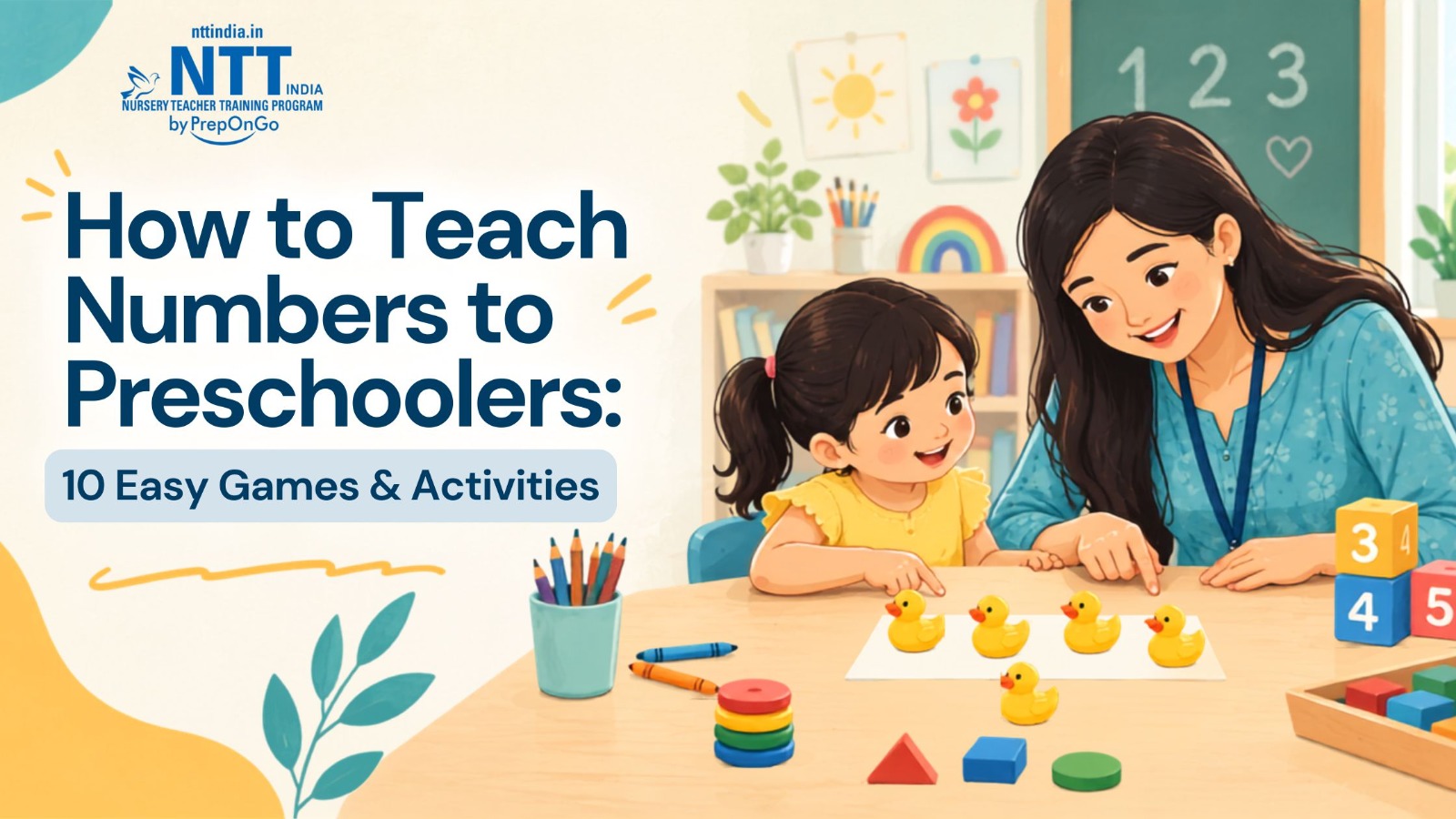
How to teach numbers to preschoolers starts with helping children understand what numbers mean, connect numerals with real quantities, notice patterns and enjoy the process of counting. It is not about making children memorise a long list of numerals.
The best number activities are simple enough to repeat, flexible enough to adapt and hands-on enough to keep children involved. A teacher might use blocks, beads, toys, pencils, buttons or even classroom snacks to turn an abstract number into something a child can see and touch.
This approach fits naturally with activity-based learning in preschool, where children learn through doing, exploring and participating rather than only listening.
Below are 10 easy number games and activities that preschool teachers can use in the classroom or parents can adapt for learning at home.
How to Teach Numbers to Preschoolers Through Everyday Play
What Should Preschoolers Learn About Numbers?
Before expecting children to write numbers perfectly, focus on foundational number sense. Depending on age and development, children can gradually learn to:
- Recognise common numerals such as 1–5 and gradually extend the range.
- Count objects one at a time.
- Understand that the last number counted tells how many objects there are.
- Match a numeral with a group of objects.
- Put small numbers in sequence.
- Compare simple quantities using ideas such as more, less and the same.
- Notice simple patterns and relationships between quantities.
10 Easy Number Games & Activities for Preschoolers
1. Count What You See
Choose everyday classroom objects such as pencils, blocks, crayons or toy animals. Place a small group in front of the children and ask them to count each item by touching or moving it once.
Teacher tip: Start with small quantities. Accuracy matters more than speed.
2. Build a Number Tower
Give children blocks and a number card. If the card shows 5, the child builds a tower using five blocks. Change the card and repeat.
This connects the written numeral with a real quantity and also develops fine-motor skills.
3. Number Hunt
Place number cards around the classroom. Call out a number and ask children to find the matching card. For an easier version, show a picture of the number first.
You can turn it into a movement game by asking children to walk, hop or tiptoe to the correct number.
4. Count While You Move
Learning does not have to happen at a table. Ask children to jump five times, clap four times, stamp three times or take six steps while counting aloud.
Movement makes counting memorable and can be especially useful when children are losing attention.
5. Sort and Count
Give children mixed objects such as buttons, blocks or coloured counters. Ask them to sort the objects first and then count each group.
For example: ‘How many blue blocks do we have? How many red blocks?’ This combines early numeracy with sorting and classification.
6. Snack-Time Counting
Use snack time as a natural counting opportunity. Ask children to count how many fruit pieces, crackers or other suitable items are on their plate.
Keep the activity simple and practical. The goal is to connect numbers with real-life quantities.
7. Number and Colour Match
Prepare numeral cards and groups of coloured objects. Children match the numeral to the correct number of objects.
For example, a card showing 4 can be matched with four yellow counters. Later, remove the colour clue so children focus on quantity.
8. What’s Missing?
Place number cards in a simple sequence such as 1, 2, 3, 5. Ask children which number is missing. Begin with small ranges and increase the challenge gradually.
This helps children notice order and sequence instead of only recognising individual numerals.
9. Tell a Number Story
Use a short story to introduce counting. For example: ‘Three birds were sitting on a branch. Two more birds came. How many birds are there now?’ Use toys or picture cards to act it out.
Story-based maths gives children a reason to use numbers instead of treating them as isolated symbols.
10. Let Children Create the Game
Once children are comfortable with simple counting, invite them to invent their own number game using blocks, cards or classroom objects.
Ask: ‘What number should we make?’ or ‘Can you make a group of six?’ This encourages children to think about numbers creatively.
Why Hands-On Number Activities Work
Knowing how to teach numbers to preschoolers becomes easier when children can physically interact with mathematical ideas. A numeral such as 5 is an abstract symbol. Five blocks, five beads or five toy animals make that quantity visible.
NTT India’s arithmetic curriculum similarly emphasises counting, number recognition and the use of concrete materials such as blocks and counters to help young learners understand early mathematical concepts.
Hands-on activities also give teachers opportunities to observe how children are thinking. A child may recognise the numeral 5 but still struggle to count five objects accurately. Another child may count confidently but not recognise the written numeral. These observations help teachers decide what to practise next.
Number Recognition vs Counting: What’s the Difference?
These skills are related, but they are not identical.
- Number recognition means identifying the written symbol, such as recognising that ‘4’ represents four.
- Counting means assigning one number word to each object in a group.
- Quantity understanding means knowing that the final counting number tells how many objects are in the group.
A strong preschool number activity should therefore give children opportunities to see numerals, say number words, move objects and compare quantities—not just trace worksheets.
Common Mistakes to Avoid When Teaching Numbers
- Making children repeat number names without connecting them to quantities.
- Moving to large numbers before children are comfortable with smaller quantities.
- Using worksheets as the main teaching method.
- Correcting every mistake immediately instead of allowing children to think and try again.
- Focusing on speed rather than understanding.
- Using the same activity repeatedly until children lose interest.
If attention starts to drop, change the activity instead of simply repeating the instructions. This connects with NTT India’s guidance on keeping preschool children engaged in class, including short activities, movement, games, hands-on learning and opportunities for children to participate.
A Simple 15-Minute Number Lesson Plan
| Time | Activity | Purpose |
| 2 minutes | Number warm-up | Say and show the target number. |
| 4 minutes | Hands-on counting | Count blocks, beads or everyday objects. |
| 4 minutes | Number game | Use a hunt, matching game or movement activity. |
| 3 minutes | Challenge question | Ask children to compare or find a missing number. |
| 2 minutes | Review | Ask children to show or explain what they learned. |
For more support with planning activities like this, teachers can also refer to NTT India’s guide to lesson planning for preschool teachers.
How Teachers Can Make Number Learning More Meaningful
The strongest preschool maths lessons show that how to teach numbers to preschoolers does not have to feel like a maths test. It should feel like exploration, conversation and guided discovery.
- Use familiar objects whenever possible.
- Ask children questions instead of giving every answer.
- Let children touch, move, sort and build.
- Repeat important concepts in different ways.
- Give children enough time to respond.
- Celebrate effort and participation.
- Observe children during activities to understand what they can do independently.
These practices also connect with broader early literacy and numeracy foundations that help teachers build strong early learning experiences.
Frequently Asked Questions
How to Teach Numbers to Preschoolers: What Is the Easiest Way?
A simple way to teach numbers to preschoolers is to start with small quantities and real objects. Ask children to count, touch, move and match objects with simple numeral cards.
How can I make counting fun for preschool children?
Use games such as number hunts, movement counting, block towers, sorting games, snack-time counting and number stories.
Should preschoolers learn to write numbers first?
Not necessarily. Number recognition, counting and understanding quantity are important foundations. Writing can be introduced progressively alongside these skills.
How many numbers should a preschooler learn at one time?
There is no single number range that fits every child. Begin with small quantities and extend gradually according to the child’s development and understanding.
Can everyday objects be used to teach maths?
Yes. Blocks, pencils, buttons, beads, toys, fruits and other safe everyday objects can make quantities easier for young children to understand.
Final Thoughts
When teachers know how to teach numbers to preschoolers through meaningful, playful experiences, number learning becomes much easier. The goal is not to make every lesson look like formal mathematics. It is to help children build number sense through practical experiences.
A simple set of blocks can become a counting game. A classroom walk can become a number hunt. Snack time can become a lesson in quantity. When teachers use these everyday moments intentionally, children begin to see that numbers are part of the world around them.
For educators who want to build stronger skills in child development, classroom management, activity-based learning and early numeracy, explore the NTT India early childhood education programme and its practical teacher-training resources.
Helpful NTT India Resources
- Activity-Based Learning in Preschool
- Arithmetic Curriculum
- Lesson Planning for Preschool Teachers
- How to Keep Preschool Children Engaged in Class
- Early Literacy and Numeracy Foundations
For broade