







How to Handle Tantrums in Preschool: 9 Calm, Practical Strategies for Teachers
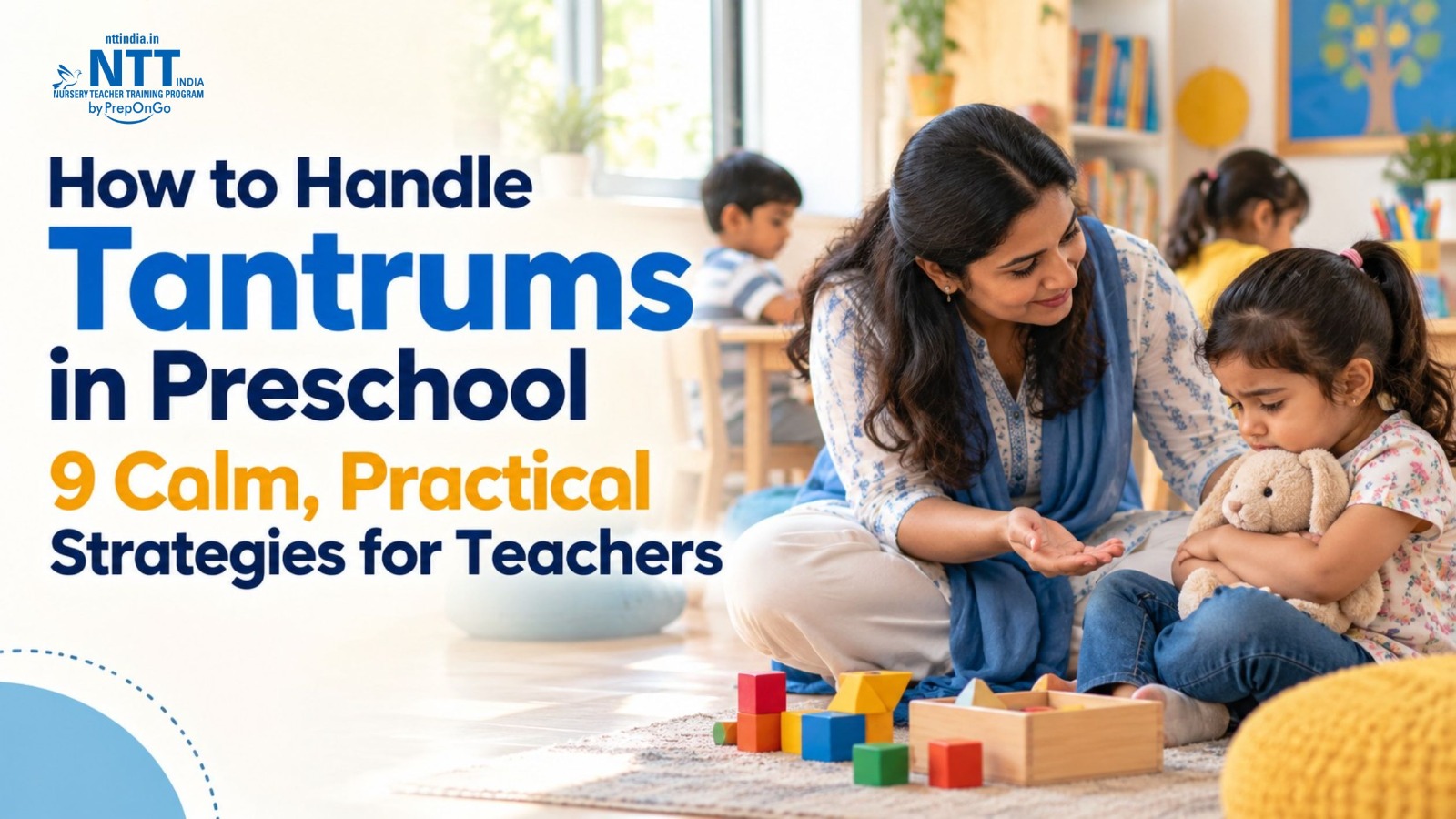
How to handle tantrums in preschool is one of the questions that can make even a well-prepared early-years teacher feel uncertain. A child may suddenly cry, scream, drop to the floor, throw a toy, refuse to move or become completely overwhelmed while the rest of the class is watching. In that moment, the teacher has two jobs at once: protect safety and help the child move back toward regulation without turning the situation into a public battle.
Tantrums are not unusual in the preschool years. Young children are still developing language, impulse control, flexibility and the ability to manage intense feelings. UNICEF India describes temper tantrums as a normal part of behaviour for many young children and recommends that adults respond by understanding the situation, protecting safety and offering calm support. For teachers, this means the goal is not simply to “stop the behaviour.” The larger goal is to understand what the child needs, reduce escalation and teach better ways to cope over time.
Why Preschool Tantrums Happen
A tantrum is usually the visible part of a problem that started earlier. A child may be tired, hungry, overstimulated, frustrated, unable to communicate, upset by a transition, disappointed by a limit or overwhelmed by a social situation. The same child may cope well one day and struggle the next because their capacity changes with sleep, routine, health, sensory load and emotional stress.
A teacher therefore needs to look beyond the behaviour itself. Instead of asking only, “How do I stop this?” ask, “What made this difficult for the child, and what skill or support is missing right now?”
How to Handle Tantrums in Preschool: 9 Practical Teacher Strategies
1. Regulate yourself before you regulate the child
Children notice adult tone, posture and speed. A rushed or angry response can add more pressure to an already overwhelmed child. Slow your voice, reduce unnecessary words and keep your body language steady. Calm does not mean passive; it means controlled, clear and emotionally available.
2. Make safety the first priority
If the child is kicking, hitting, throwing objects or moving toward something unsafe, quietly create space. Move hard or breakable items away, guide other children toward another activity if needed, and use a short boundary such as, “I will not let you hit. I am here to keep everyone safe.” Avoid turning the moment into a public lecture.
3. Use fewer words during the peak of the tantrum
When a child is highly distressed, long explanations are difficult to process. Avoid repeated questions, reasoning, threats or demands for apologies. Short phrases are easier to receive: “You are safe.” “I am here.” “That was hard.” “We can talk when your body is calmer.”
4. Acknowledge the feeling without giving up the boundary
Validation and limits can exist together. A teacher can say, “You are angry because you wanted another turn. It is okay to feel angry. The blocks still need to be packed away.” This helps the child feel understood while keeping the classroom expectation clear.
5. Reduce stimulation when possible
Noise, crowding and too many people watching can intensify a meltdown. If school policy and supervision allow, offer a quieter corner or slightly calmer space without presenting it as punishment. The purpose is not isolation; it is to reduce sensory and social pressure.
6. Offer simple co-regulation, not forced calming
Some children may respond to a calm adult nearby, slower breathing, a familiar comfort object, a drink of water or a choice between two acceptable options. Others may need physical space. Follow the child’s cues and avoid forcing hugs or eye contact. The teacher’s steady presence is often more useful than telling a child to “calm down.”
7. Wait until the child is calm before teaching
The middle of a tantrum is rarely the best time to explain consequences, practise language or discuss what should have happened. Wait for signs that the child is recovering: slower breathing, quieter voice, renewed awareness of the teacher or willingness to re-engage. Teaching works better after regulation.
8. Reconnect and teach one replacement skill
After the child is calm, briefly name what happened and practise one more helpful response. For example: “You were upset when playtime ended. Next time you can say, ‘One more turn please,’ or ask me for help.” Keep the follow-up short, specific and free from shame.
9. Look for patterns and prevent the next escalation
The strongest behaviour guidance happens before the tantrum. Record patterns: Does it happen before lunch? During clean-up? In noisy group time? When sharing a favourite toy? Use the pattern to adjust routines, give advance warnings, simplify waiting, prepare visual cues or teach the needed language before the difficult moment begins.
What Teachers Can Say During a Preschool Tantrum
A small set of familiar phrases is more useful than trying to invent the perfect response under pressure. Teachers can adapt language to the child and school context:
- “You are safe. I am staying nearby.”
- “You are very upset. I can see that.”
- “I will not let you hurt yourself or someone else.”
- “We can solve this when you are calmer.”
- “Would you like me close, or would you like a little space?”
- “When you are ready, I will help you come back.”
What Usually Makes a Tantrum Harder
Even well-meaning responses can accidentally increase stress. During a major emotional outburst, try to avoid:
- raising your voice to overpower the child
- asking “Why are you doing this?” again and again
- demanding an immediate apology
- giving long explanations while the child is crying or screaming
- publicly comparing the child with classmates
- labeling the child as “naughty,” “difficult” or “attention-seeking”
- changing a reasonable boundary simply to end the scene
- forcing physical affection or eye contact
A Quick Tantrum Response Plan for Preschool Teachers
| Stage | Teacher Priority | Practical Response |
| Before | Prevention | Notice triggers, prepare transitions, reduce long waits, teach emotion words and keep routines predictable. |
| During | Safety + regulation | Stay calm, reduce words, protect safety, acknowledge feelings and lower stimulation. |
| After | Reconnect + teach | Name the situation briefly, practise one replacement skill and help the child return to the group. |
| Later | Reflect | Look for patterns and adjust the environment, routine or teacher response if the same trigger repeats. |
How Classroom Routines Reduce Tantrums
Tantrums often become more likely when children do not know what is happening next or have to stop a preferred activity suddenly. Predictable routines, visual schedules and transition warnings can reduce uncertainty. NTT India’s existing guide to preschool classroom transitions explains how short warnings, consistent signals and visual cues can make activity changes easier for young children.
Related reading: Preschool Classroom Transitions: 10 Simple Strategies for Smoother Routines
Why Child Psychology Matters in Behaviour Guidance
A teacher who understands child development is more likely to interpret behaviour as communication rather than personal defiance. Child psychology helps educators recognise developmental limits, emotional needs and patterns in how young children respond to stress. That knowledge supports better decisions in difficult classroom moments.
Explore NTT India’s guide: Child Psychology for Teachers
When a Tantrum Needs More Attention
Teachers should not diagnose a child based on classroom behaviour. However, repeated or unusually intense outbursts may deserve closer observation and communication with the family, especially when they frequently interfere with daily functioning, cause injury, appear across settings or are accompanied by other developmental concerns. UNICEF India advises seeking professional guidance when tantrum episodes are frequent, disruptive to routine or causing harm. Follow the preschool’s safeguarding and referral procedures, document observations objectively and speak with families respectfully rather than making assumptions.
How NTT India Prepares Teachers for Real Classroom Situations
Knowing the theory of early childhood education is important, but teachers also need the confidence to respond when a real classroom becomes unpredictable. NTT India’s current ECCE programme includes child psychology, play-based pedagogy, classroom practice and practical training designed to help aspiring educators understand young children and manage learning environments more effectively.
Explore the programme: NTT India ECCE Courses
Frequently Asked Questions
Should a preschool teacher ignore a tantrum?
Not completely. Some attention-seeking behaviours may reduce when adults avoid reinforcing them, but the teacher still has responsibility for safety, supervision and emotional support. Stay calm, reduce unnecessary attention to the performance of the tantrum, and remain available to help the child regulate.
Should I tell a preschooler to calm down?
Usually, “calm down” by itself does not give the child a skill. It is more useful to lower your own voice, use short reassuring language and model the calm behaviour you want to see.
What is the first thing to do when a child is hitting during a tantrum?
Protect safety. Block or move away from harmful actions where appropriate, move objects or classmates if necessary, and use a short clear boundary. Follow your school’s behaviour and safeguarding policy.
How can teachers prevent tantrums during transitions?
Give short advance warnings, use predictable transition signals, keep waiting time low, prepare the next activity before moving the group and use visual cues when helpful.
When should teachers speak to parents about tantrums?
When a pattern is repeated, intense, affecting participation or creating safety concerns, share objective observations with the family. Describe what happened, when it happened, what came before and what helped—without labels or diagnosis.
What is the best way to handle tantrums in preschool?
The best response combines calm adult behaviour, safety, simple language, co-regulation, appropriate boundaries and later teaching. Prevention through predictable routines and understanding triggers is equally important.
Final Takeaway
Learning how to handle tantrums in preschool is not about finding one phrase that instantly stops every outburst. It is about becoming the kind of teacher who can stay steady when a child cannot. Safety comes first. Regulation comes before reasoning. Teaching comes after calm. And prevention begins with understanding the child, the classroom environment and the patterns behind the behaviour.
For aspiring preschool educators, these moments are exactly why professional early-childhood training matters. Strong teachers do more than deliver activities—they observe, respond, guide, communicate and help young children gradually build the emotional skills they are still learning.