






How Preschool Teachers Can Communicate With Parents: 9 Practical Strategies for Building Trust
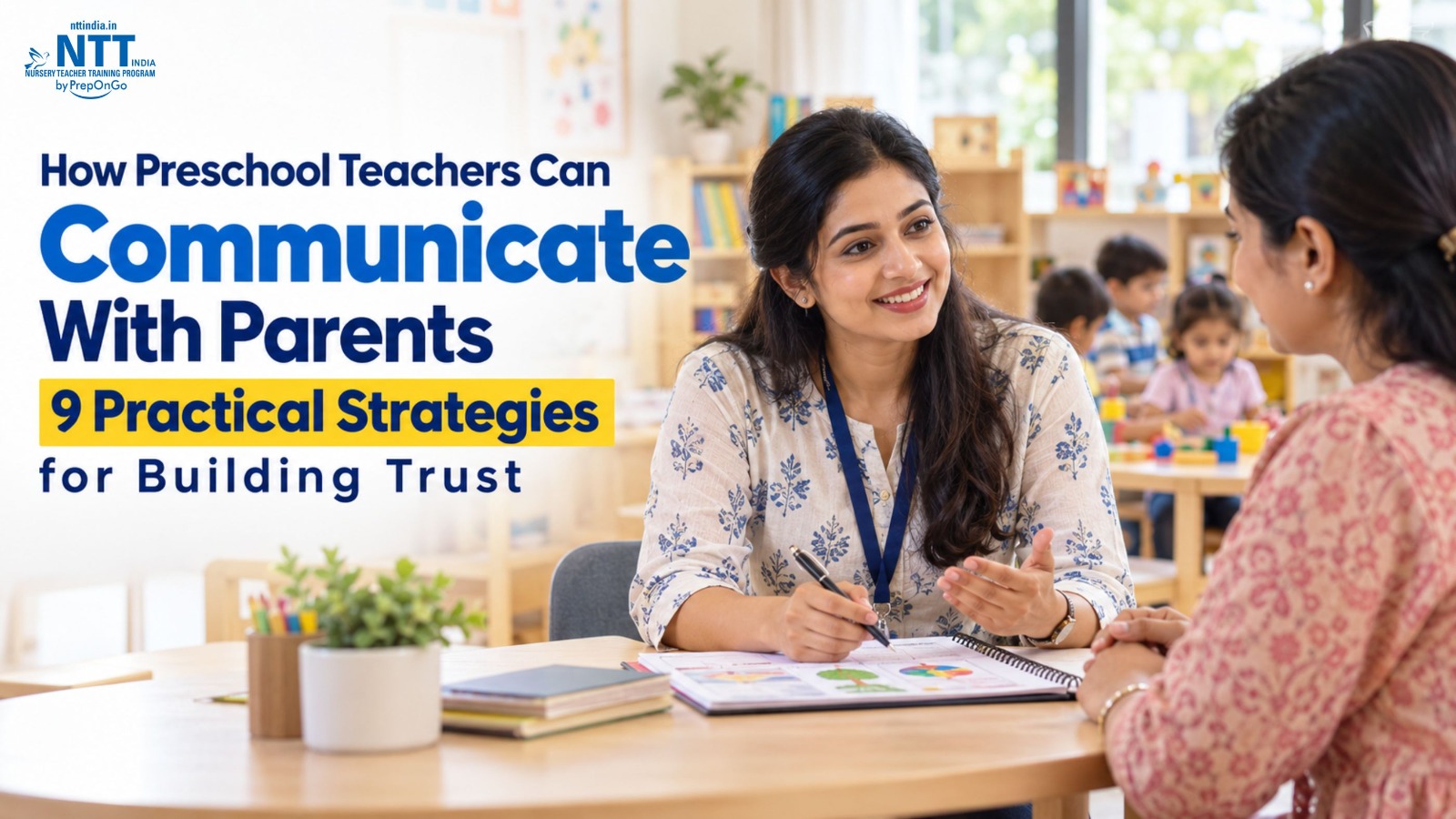
Preschool teacher communication with parents is one of the most important professional skills in early childhood education. A child may have had a difficult morning, started speaking more confidently during circle time, or become more independent with clean-up while still needing support to join group play. A preschool teacher has to notice these moments, understand what they may mean, and communicate them to families clearly and respectfully.
In early childhood education, communication with families is not an extra task added after teaching. It is part of professional teaching itself. Parents know the child’s history, routines, preferences and experiences outside school; teachers see the child in a group-learning environment across play, routines, interactions and activities. When those two perspectives are shared respectfully, adults can make better decisions for the child.
India’s National Curriculum Framework for the Foundational Stage describes parents and families as co-partners in children’s learning and calls for communication that is frequent, ongoing and based on equal partnership. NCERT’s preschool curriculum guidance similarly encourages collaboration between teachers, families and communities. These principles make parent communication a core professional skill for preschool educators, not merely a reporting exercise.
What Good Preschool Teacher Communication With Parents Looks Like
Good preschool teacher communication with parents is clear enough for a family to understand, specific enough to be useful, respectful enough to preserve trust, and open enough to invite the family’s perspective. It does not mean sending constant updates. It means sharing the right information at the right time, in language that is factual, child-focused and easy to act on.
A simple principle helps: observe → describe → ask → agree on the next step → follow up.
1. Build the Relationship Before There Is a Problem
If the first meaningful conversation a family has with a teacher happens only when something has gone wrong, even a reasonable concern can feel alarming. Create small positive points of contact early: greet families by name when possible, mention a specific success, share a moment of participation, or ask a simple question about the child’s routine.
A short message such as “Aarav joined the action rhyme independently today and copied all four movements” gives a parent useful information and shows that the teacher is actually observing the child. Later, if a concern needs to be discussed, there is already a foundation of trust.
2. Describe What You Observed—Do Not Label the Child
Preschool communication becomes more professional when teachers report observable behaviour rather than assigning a personality label. Words such as “naughty,” “lazy,” “stubborn,” “aggressive” or “weak” are broad judgments. They do not tell the parent what actually happened, and they can quickly make a conversation defensive.
Instead, describe the situation: what happened before the behaviour, what the child did, what support was offered and what happened next. This keeps the discussion factual and makes it easier for the family and teacher to look for patterns together.
Use observation-based language
| Avoid | Try instead |
| “She is very stubborn.” | “When free-play ended, she continued with the puzzle after the clean-up cue and needed two individual reminders.” |
| “He never listens.” | “During the three-step instruction, he completed the first step and then looked to another child for what to do next.” |
| “She is shy.” | “She answered me quietly one-to-one today, but did not yet volunteer an answer in the group.” |
| “He is weak in numbers.” | “He counts objects accurately to five but is still matching some numerals to quantities inconsistently.” |
3. Share Progress, Not Only Problems
Consistent preschool teacher communication with parents should include growth as well as difficulty. Families should not have to wonder whether a message from school automatically means bad news. Progress may be academic, but it may also involve independence, language, participation, self-regulation, friendships, confidence or everyday routines.
Specific progress statements are more useful than general praise. “She did well today” is pleasant but vague. “She stayed with the sorting activity until she completed all four groups and then explained her choices” tells the parent what the teacher noticed.
4. Ask Families for Context Before Reaching a Conclusion
Preschool behaviour can change because of sleep, illness, travel, a new sibling, a change in caregiver, language transitions, family events or many other everyday factors. A teacher usually sees only the school side of the picture. Before assuming why a child’s behaviour has changed, ask.
Useful questions include: “Have you noticed this at home too?”, “Has anything changed in the morning routine?”, “What usually helps when she feels frustrated?” and “Which words do you use at home for this routine?” The goal is not to investigate the family; it is to gather relevant context that may help the child.
5. Use the Right Channel for the Right Message
Preschool teacher communication with parents works best when the channel matches the message. Routine reminders can be brief and written. Individual progress can be shared privately. Sensitive behavioural, developmental, safety or wellbeing concerns are usually better handled through an approved private meeting or call, according to the school’s policy.
A practical communication rhythm
| Type | Best use | Example |
| Daily / as needed | Essential logistics or short observations | Schedule reminder; item needed; brief positive moment |
| Weekly | Learning snapshot | What the group explored; simple extension idea for home |
| Periodic meeting | Development and progress discussion | Strengths, observations, next goals, questions from family |
| Private meeting / call | Sensitive concern | Behaviour pattern, repeated difficulty, wellbeing or safety issue |
Always follow your school’s privacy and child-protection procedures. Avoid discussing one child’s behaviour, assessment information or family circumstances in front of other families or in a general group chat.
6. Explain the Learning Behind the Activity
Parents may see children painting, sorting buttons, playing with blocks or pretending to run a shop and wonder where the “learning” is. Teachers can strengthen trust by briefly connecting activities to the skills being practised.
For example: “The children used tongs to move pom-poms by colour today. The activity combined colour sorting, hand-eye coordination and fine-motor control.” This kind of explanation helps families understand why play-based learning is purposeful.
NTT India’s current ECCE programme emphasises play-based pedagogy, child development, literacy and numeracy, health and safety, and practical classroom experience. Explore the NTT India ECCE programme for the programme overview and current curriculum information.
7. Prepare for Difficult Conversations
A challenging conversation becomes easier when the teacher prepares facts and a purpose instead of speaking from frustration. Before meeting a parent, write down the specific pattern you observed, when it happens, how often it has occurred, what strategies have already been tried, and what question you want to ask the family.
Begin with the shared goal: supporting the child. Then describe observations calmly, invite the parent’s perspective, and decide on one or two practical next steps. Do not diagnose a child, make medical claims or promise outcomes that are outside the teacher’s professional role. When specialist input may be appropriate, follow the school’s escalation and referral process.
When progress or concerns are discussed, observation matters. NTT India’s existing guide on assessment in early childhood education explains the role of observation, portfolios and anecdotal records in understanding children without relying on formal exams.
8. Make Communication Two-Way
Effective preschool teacher communication with parents is two-way. Communication is not complete simply because a teacher has delivered information. Families should have a real opportunity to respond, ask questions, share priorities and explain what they are seeing at home. Two-way communication helps teachers interpret classroom observations with more context.
A useful closing question is: “What are you noticing at home that would help me support her better here?” This shifts the relationship from teacher-as-reporter to teacher-and-family-as-partners.
The National Curriculum Framework for the Foundational Stage explicitly encourages teachers to understand children’s home situations and treat families as equal partners rather than people who are merely reported to. Read the official NCF Foundational Stage document.
9. Close the Loop With a Follow-Up
Trust grows when families can see that a conversation led somewhere. If a teacher and parent agreed to try a shorter goodbye routine, a visual cue, a particular phrase, or extra practice with a classroom routine, check back after an appropriate period.
The follow-up can be very simple: “We tried the picture cue for four mornings. She is now moving to the activity table with one reminder instead of three. Are you seeing any change at home?” This turns communication into a process of shared problem-solving rather than a one-time complaint.
A 5-Minute Parent Meeting Checklist for Preschool Teachers
- Start with one genuine strength or recent success.
- Describe one or two specific observations instead of using labels.
- Explain what the teacher or classroom has already tried.
- Ask the family what they are observing at home.
- Agree on one realistic next step for school and, if appropriate, home.
- Confirm how and when you will follow up.
- Keep private details confidential and document concerns according to school procedure.
Useful Parent-Communication Phrases Teachers Can Adapt
| Situation | Possible wording |
| To share progress | “I noticed something positive today: she stayed with the activity even when it became difficult and asked for help instead of leaving it.” |
| To raise a concern | “I want to share a pattern I have noticed over the last few days and hear what you are seeing at home as well.” |
| To avoid blame | “This seems to happen most often during clean-up. We are trying a visual cue and giving an individual reminder before the group signal.” |
| To invite partnership | “What usually helps him when a routine changes at home?” |
| To close a meeting | “Let us try these two steps for a week and connect again next Friday to compare what we are noticing.” |
Common Parent-Communication Mistakes to Avoid
- Only contacting families when something goes wrong.
- Using labels such as “naughty,” “slow,” “attention-seeking” or “problem child.”
- Comparing one child with another child or sibling.
- Discussing a child’s private information in a group chat or public pickup area.
- Sending a long emotional message immediately after a difficult incident.
- Giving parents a list of problems without explaining what the teacher has observed or tried.
- Making diagnoses or medical claims outside the teacher’s professional scope.
- Promising that a strategy will definitely “fix” a child’s behaviour.
- Using technical education terms without explaining what they mean.
Frequently Asked Questions About Preschool Parent Communication
How often should preschool teachers communicate with parents?
There is no single ideal frequency for every school or family. Routine information can be shared through planned channels, while meaningful progress, repeated concerns or important changes should be communicated when relevant. The goal is useful, consistent communication rather than constant messaging.
What should a teacher say when a child has difficult behaviour?
Describe the specific behaviour, context and pattern; explain how the classroom responded; ask what the family sees at home; and agree on a practical next step. Avoid negative labels and comparisons.
Should teachers share assessment information with parents?
Yes, according to school policy and in a child-appropriate way. In early childhood, assessment is commonly based on observation, participation, work samples and development over time rather than exam scores. Explain what the observation means instead of sending isolated marks.
Is WhatsApp appropriate for preschool parent communication?
It can be useful for routine communication if the school permits it, but privacy matters. Sensitive individual information should be discussed through an approved private channel rather than a general parent group.
Why is parent communication important for an ECCE teacher?
Because young children move between home and school contexts. Families and teachers each hold information that can help the other understand routines, interests, progress and concerns. Strong communication supports more consistent decisions around the child.
Final Takeaway: Communication Is Part of Professional Teaching
Strong preschool teacher communication with parents is not about sending more messages. It is about making each important conversation more useful. Observe carefully. Speak specifically. Protect privacy. Ask families what they know. Explain the learning behind classroom experiences. Agree on practical next steps and follow up.
For aspiring educators, this is one of the professional habits that separates “conducting activities” from becoming a thoughtful early-childhood teacher. Classroom skill and family partnership belong together.
If you are building your preschool-teaching career, explore NTT India’s ECCE programme, review the practical preschool teacher interview guide, and browse more teacher-development articles for classroom-focused learning.