







How to Keep Preschool Children Engaged in Class: 10 Easy Tips for Teachers
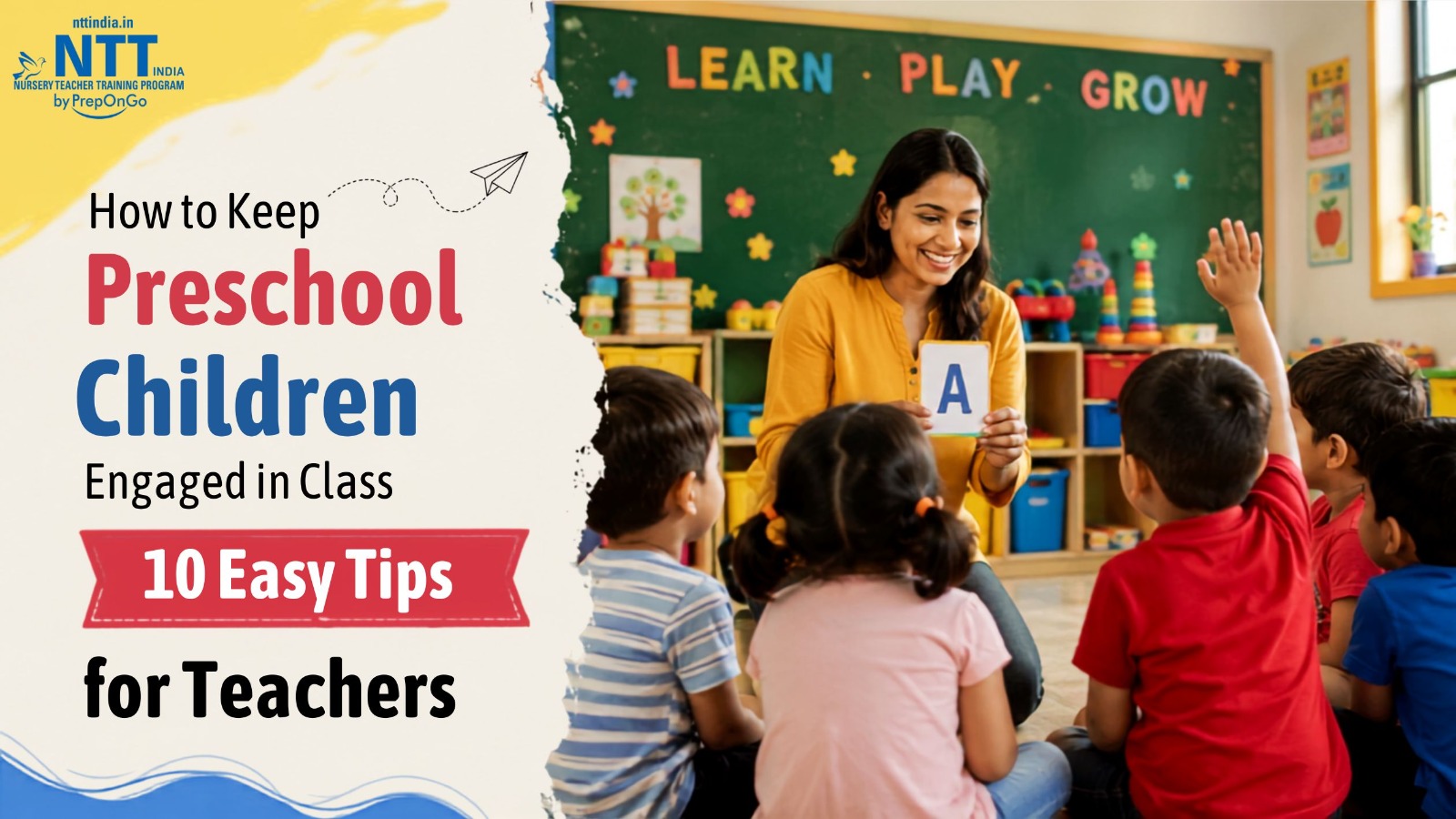
Keeping preschool children engaged in class can be challenging.
One child may be excited about the activity, another may be looking around the room, while someone else may suddenly decide that the classroom floor is much more interesting than the lesson.
This is normal.
Young children are naturally curious, active, and eager to explore. Their learning is strongly connected to movement, interaction, play, communication, and hands-on experiences. UNICEF India recommends play-based activities, movement, storytelling, matching and sorting games, art, music, and opportunities for children to ask questions and participate. (UNICEF)
For preschool teachers, therefore, the goal should not simply be to make children sit quietly.
The real goal is to help them participate, explore, communicate, and enjoy learning.
Here are 10 simple ways teachers can improve preschool classroom engagement.
-
Keep Activities Short and Simple
Preschool children usually respond better to short, focused learning activities than to long explanations.
Instead of spending 20 minutes explaining one concept, divide the lesson into smaller parts.
For example, if you are teaching numbers:
- Introduce the number.
- Show a visual.
- Let children count objects.
- Play a quick counting game.
- Ask children to demonstrate what they learned.
This gives children several opportunities to participate instead of simply listening.
NTT India’s own guidance for young learners recommends keeping activities short and focused to support children’s attention. (Nursery Teacher Training Program India)
Teacher tip
Ask yourself:
“What is the one thing I want children to learn from this activity?”
Then build the activity around that one objective.
-
Turn Lessons Into Games
For young children, learning does not always need to look like a traditional lesson.
A simple game can turn a difficult concept into something children want to explore.
For example:
Teaching colours:
Ask children to find something red in the classroom.
Teaching numbers:
Give children blocks and ask them to build a tower with five blocks.
Teaching shapes:
Ask children to find circles, squares, or triangles around the classroom.
Teaching letters:
Hide letter cards around the room and turn the lesson into a simple letter hunt.
The idea is simple:
Don’t only tell children what to learn. Give them something to do with what they are learning.
India’s early childhood education guidance emphasizes play, activity, and learning by doing rather than repetitive or primarily rote tasks. (Education Ministry of India)
-
Use More Hands-On Learning
One of the easiest ways to increase engagement is to give children something they can touch, move, build, sort, match, or create.
Instead of teaching numbers only with a worksheet, use:
- Blocks
- Buttons
- Counters
- Number cards
- Puzzles
- Beads
- Everyday classroom objects
For example, while teaching counting, ask children to physically count five blocks and place them in a row.
This turns an abstract concept into a real experience.
Activity-based learning is built around exactly this principle: children actively participate through hands-on activities, games, and real-life experiences. (Nursery Teacher Training Program India)
-
Let Children Move
A preschool classroom does not have to mean children sitting in one place for the entire lesson.
Movement can actually become part of learning.
Try activities such as:
- Jump five times while counting.
- Clap when you hear a particular sound.
- Walk to the correct number card.
- Act like different animals during a story.
- Move to different corners of the classroom based on colours or shapes.
Movement breaks can also help when children’s attention starts to drop.
Recent early-childhood guidance and classroom research highlight movement, play, choice, and interaction as important parts of keeping young children engaged. (UNICEF)
-
Ask Questions Instead of Only Giving Instructions
A teacher can easily spend most of a lesson talking.
But engagement increases when children get opportunities to think and respond.
Instead of:
“This is a triangle.”
Try:
“Can you find something in this room that looks like a triangle?”
Instead of:
“The plant needs water.”
Ask:
“What do you think will happen if we don’t water the plant?”
Simple open-ended questions encourage children to observe, think, communicate, and share their ideas. UNICEF India also recommends questions such as “What do you think will happen?” to encourage active participation and deeper thinking. (UNICEF)
Try these questions:
- “What do you notice?”
- “What do you think will happen?”
- “Why do you think that?”
- “Can you show me?”
- “What else could we try?”
-
Use Stories, Songs and Role Play
Storytelling is one of the easiest ways to capture a preschooler’s attention.
Instead of simply reading a story, make children part of it.
You can:
- Change your voice for different characters.
- Use simple puppets.
- Ask children to make animal sounds.
- Let children act out parts of the story.
- Pause and ask what they think will happen next.
Songs and rhymes can also be used to introduce numbers, letters, colours, body parts, routines, and other concepts.
This approach makes learning more interactive and gives children multiple ways to participate.
-
Give Children Small Choices
Children are more likely to participate when they feel that they have some control over their learning.
You don’t need to give them complete freedom.
Give them two simple choices.
For example:
“Would you like to use crayons or coloured pencils?”
or
“Would you like to build the number with blocks or match the number cards?”
This small choice can make children feel involved rather than simply instructed.
Research on preschool engagement has found that activity settings offering children greater choice can be associated with more positive engagement with peers and tasks. (ScienceDirect)
-
Connect Learning to Things Children Already Know
Young children understand new ideas more easily when teachers connect them to familiar experiences.
For example, while teaching counting, use:
- Fruits
- Toys
- Pencils
- Shoes
- Blocks
- Snacks
Instead of asking:
“What is the number 5?”
You could ask:
“How many pencils are on your table?”
The concept becomes connected to something children can actually see and experience.
This is also why low-cost everyday materials can be useful in early learning. UNICEF India recommends using simple materials such as buttons, seeds, paper scraps, and other familiar objects for activities such as counting, sorting, and art. (UNICEF)
-
Appreciate Participation, Not Just Correct Answers
If children believe that they will only receive praise when they give the “right” answer, they may become hesitant to participate.
Instead, recognize their effort and curiosity.
Try saying:
- “Good thinking!”
- “I like how you tried that.”
- “That’s an interesting idea.”
- “Let’s try it together.”
- “You noticed something important.”
A supportive classroom gives children confidence to ask questions, make mistakes, and try again.
India’s foundational-stage guidance emphasizes a warm, safe, child-friendly environment where children can express themselves and learn without fear. (DSEL Education)
-
Change the Activity Before Children Lose Interest
One of the biggest mistakes teachers can make is waiting until children are completely distracted before changing the activity.
Watch the classroom.
If children are:
- Looking around frequently
- Talking to friends
- Leaving their seats
- Losing interest
- Stopping participation
it may be time to change the pace.
You could move from:
Story → Song → Movement → Hands-on activity → Drawing
instead of continuing with one type of activity for too long.
Recent preschool engagement guidance also recommends small “curiosity bursts,” movement, changes to the learning environment, and playful activities when children’s energy begins to fade. (Edutopia)
A Simple Preschool Engagement Formula
If you are planning a preschool lesson, remember this simple structure:
Explain → Show → Do → Ask → Move → Review
For example, while teaching shapes:
Explain:
“This is a circle.”
Show:
Show a large circle card.
Do:
Let children make circles using clay.
Ask:
“Can you find a circle in our classroom?”
Move:
Ask children to stand near something circular.
Review:
“What shape did we learn today?”
This approach gives children several chances to interact with the same concept.
What If a Child Still Doesn’t Participate?
Not every child will engage in the same way.
One child may answer every question.
Another may prefer observing.
A shy child may participate through drawing rather than speaking.
A child who is highly active may need more movement.
This is why preschool engagement should not mean making every child behave in exactly the same way.
Teachers should observe children’s interests, strengths, responses, and challenges and adapt activities accordingly. Guidance on engaging every child recommends observing and listening to children, reflecting on what teachers notice, and providing different ways for children to express what they know and can do. (Illinois Early Learning)
The question should be:
“How can I help this child participate?”
rather than:
“Why isn’t this child listening?”
Why Practical Teaching Skills Matter for Preschool Teachers
Knowing that children learn through play is one thing.
Knowing how to turn that idea into an actual classroom activity is another.
A preschool teacher needs to know how to:
- Plan age-appropriate activities
- Use teaching aids
- Encourage participation
- Handle different learning needs
- Use stories and games
- Create hands-on learning experiences
- Observe children’s responses
- Adapt activities when children lose interest
This is where practical teacher training can make a difference.
NTT India’s ECCE program includes play-based pedagogy, practical training, workshops, classroom practice, internship, and teaching-focused learning designed to prepare educators for real classroom situations. (Nursery Teacher Training Program India)
Explore the NTT India ECCE Program
Frequently Asked Questions
How can I keep preschool children engaged in class?
Use short activities, games, movement, storytelling, hands-on materials, questions, and opportunities for children to make simple choices. The key is to keep children actively involved rather than asking them to listen for long periods.
What activities keep preschool children engaged?
Storytelling, songs, role play, puzzles, sorting, matching, blocks, art and craft, movement games, sensory activities, and simple classroom hunts can all encourage participation.
How long should a preschool activity last?
There is no single ideal duration for every child or activity. Teachers should consider the children’s age, developmental stage, interest, and the complexity of the activity. Short, focused activities with changes in pace are generally more suitable than long teacher-led explanations.
How do you handle a preschool child who does not participate?
First observe why the child may not be participating. They may be shy, tired, unsure of the activity, overwhelmed, or interested in a different type of learning. Offer different ways to participate, such as drawing, movement, building, speaking, or working with a partner.
Is activity-based learning useful in preschool?
Yes. Activity-based and play-based approaches allow children to learn through doing, exploring, interacting, and experimenting. India’s ECCE guidance emphasizes play, activity, and learning by doing as appropriate approaches for preschool education. (Education Ministry of India)
Final Thoughts
Keeping preschool children engaged does not mean keeping them silent or seated throughout the day.
It means creating opportunities for them to move, explore, ask questions, make choices, create, communicate, and learn through experience.
A successful preschool teacher knows when to explain, when to ask, when to demonstrate—and when to simply let children explore.
The more practical your teaching approach becomes, the more opportunities children have to become active participants in their own learning.
If you want to develop practical skills for working with young learners, explore the ECCE teacher training program by NTT India, which combines modern early-childhood education concepts with practical learning and classroom experience. (Nursery Teacher Training Program India)