






Preschool Observation Checklist for Teachers: What to Observe and How to Record It
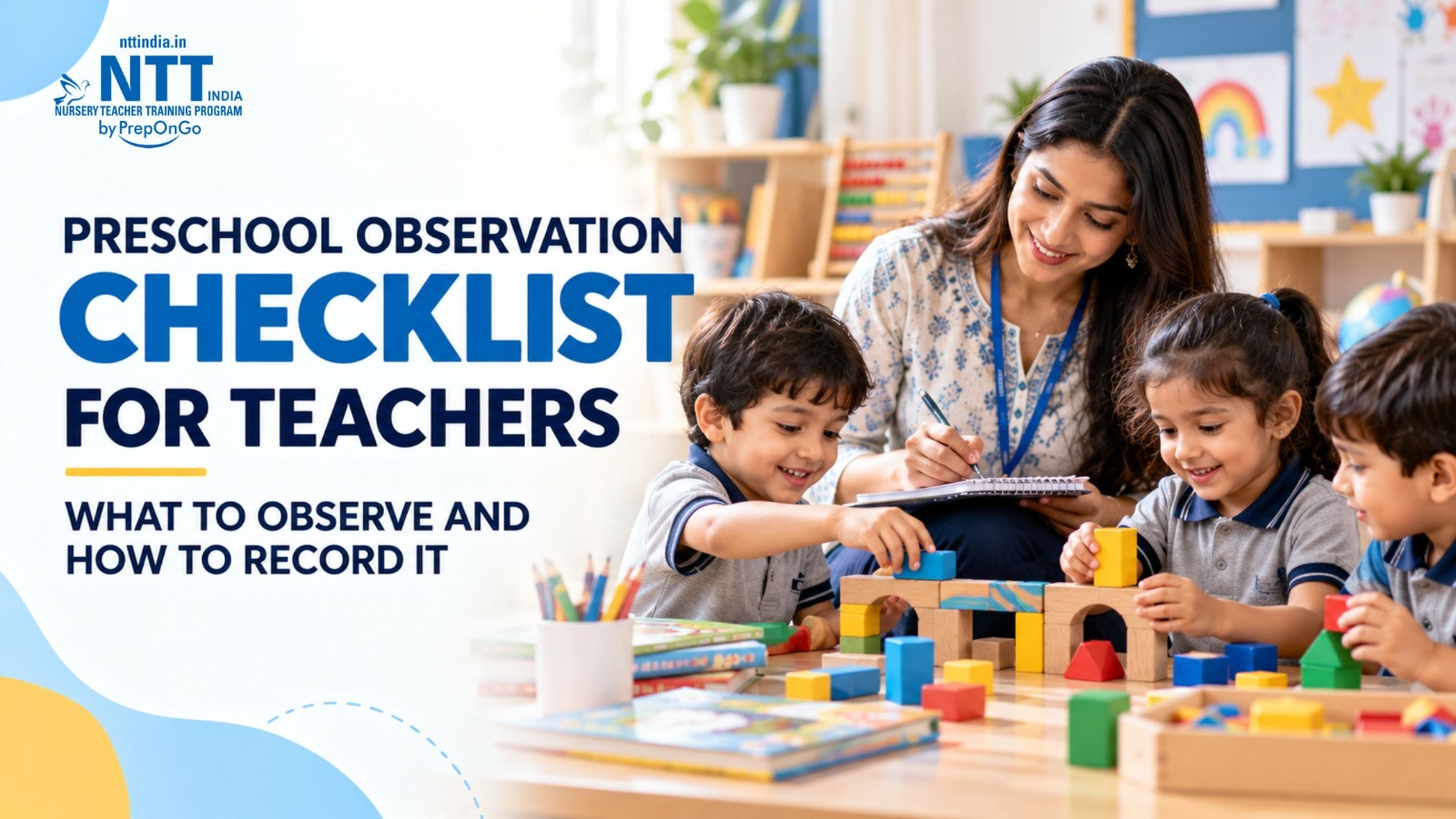
A preschool observation checklist for teachers turns everyday classroom moments into useful evidence of children’s learning. During story time, block play, snack, outdoor movement and conversations, teachers notice far more than whether a child completes an activity. The challenge is to record these moments fairly, without interrupting play or turning a child into a score.
This practical guide explains what to observe, how to write short factual notes, when to review patterns and how to use what you learn to plan the next activity. It is designed for nursery teachers, NTT trainees and early childhood educators working with different ages, languages and abilities.
Why a preschool observation checklist matters
Observation is not a test and is not a diagnosis. It helps teachers see emerging interests, participation, strengths and support needs over time. The National Curriculum Framework for Foundational Stage identifies observation and analysis of children’s work as appropriate assessment methods, and encourages planning, evidence gathering and reflection. A checklist is useful only when it leads to responsive teaching rather than comparisons between children.
What should teachers observe? Six practical areas
Communication and language
Does the child describe a picture, ask a question, follow a familiar direction or communicate through gesture, home language or speech?
Social interaction and emotional expression
How does the child join play, take turns, seek help, respond to a disagreement or express a feeling?
Early literacy and storytelling
Does the child attend to a story, recognise familiar symbols, retell an event or explore books voluntarily?
Early numeracy and problem-solving
Does the child match, sort, compare quantities, notice patterns or test a construction idea?
Movement and independence
How does the child handle crayons or blocks, move safely, wash hands, manage belongings or attempt self-care?
Creativity, curiosity and engagement
What materials attract the child? Does the child experiment, pretend, persist or suggest a new way to play?
A ready-to-use preschool observation checklist for teachers
Use the prompts below as a flexible planning aid, not as a universal pass/fail developmental scale. Record the context, support provided and evidence rather than only a tick.
| Area | Look for | Evidence to note |
| Language | Questions, gestures, storytelling | Exact words or communication method |
| Social-emotional | Turn-taking, asking for help | Situation and response |
| Early literacy | Book interest, picture talk | What child said or pointed to |
| Early maths | Sorting, counting, patterns | Materials and strategy |
| Motor and self-care | Grip, movement, independence | What child did with/without support |
| Creative play | Pretend roles, new ideas | Actions and choices |
How to record objective observation notes: five steps
1. Choose one focus
Select one learning goal or question and observe a few children at a time. Avoid trying to record everything simultaneously.
2. Write the context
Note date, setting, activity, materials and who was present. A short note after play is often more accurate than relying on memory at day’s end.
3. Describe actions, not labels
Write “Mira placed four blocks in a line and said ‘train’” rather than “Mira is brilliant at maths.” Replace “naughty” with the specific behaviour observed.
4. Record support and child voice
Note prompts, language used, adaptations and the child’s own words. A child who succeeds with modelling has demonstrated learning, not failure.
5. Review and plan
Look for patterns across days and contexts, then decide on a suitable next opportunity. Share balanced, specific observations with families when appropriate.
Example: from a classroom moment to a useful next step
Setting: block corner, small-group free play. Observation: “At 10:20 a.m., Aanya placed three rectangular blocks across two supports. The bridge fell twice. She moved the supports closer and tried again. She told her friend, ‘Now it stays.’”
Possible interpretation: Aanya experimented with balance and persisted after setbacks. Next step: offer different-sized blocks and invite children to predict which bridge might hold a toy vehicle. Do not infer a fixed ability level from this single event.
Three recording tools and when to use them
Anecdotal notes capture a meaningful incident with context. A simple checklist tracks whether a specific behaviour was observed during an opportunity. Work samples or photographs, collected with school-approved consent and storage practices, can show change over time. Combine methods; one isolated tick cannot tell the whole story.
A realistic weekly observation routine
Monday: choose one focus area and two or three children. Tuesday–Thursday: record brief notes during ordinary play and routines. Friday: review the notes, add context, identify an activity adjustment and decide what to revisit next week. This is an illustrative workflow, not a mandated assessment schedule.
Common mistakes to avoid
Avoid comparing children to classmates; recording only problems; confusing quiet participation with disengagement; using diagnostic labels; treating language differences as deficits; collecting photographs without appropriate consent; or sharing identifiable child records in public messaging groups. Follow your institution’s safeguarding and data-handling procedures.
How observation connects with nursery teacher training
Observation supports child development, play-based pedagogy, foundational literacy and numeracy, and reflective lesson planning. NTT India’s published ECCE curriculum describes these broader training areas, along with practice and internship components. Educators can use a preschool observation checklist for teachers during supervised practice to turn classroom theory into specific, child-centred decisions.
Explore NTT India’s ECCE course modules
Read NTT India’s classroom engagement guide
Read NTT India’s parent communication guide
Frequently asked questions
How often should preschool teachers record observations?
Brief, regular notes across different activities are generally more useful than a long report based on one day. Follow your school’s documentation policy.
Can a checklist replace an anecdotal record?
No. A checklist helps organise attention; an anecdotal record explains what happened and the conditions around it.
Should teachers score every child against the same milestones?
Avoid using a general classroom checklist as a diagnostic or ranking instrument. Interpret learning in context and follow relevant institutional guidance.
What if a child rarely speaks during group time?
Observe communication in other settings and languages, including gestures and one-to-one play. Discuss persistent concerns through appropriate school and family support channels.
How can observation improve lesson planning?
Use patterns in notes to adjust materials, group sizes, language prompts and opportunities for practice.
Can teachers share observation photos with parents?
Only under school policy and appropriate consent, with secure handling of identifiable child information.
Final takeaway
A preschool observation checklist for teachers works best when it captures real learning moments, respects individual differences and leads to thoughtful next steps. Begin with one area, one small group and one factual note; build consistency before adding complexity. For educators developing these skills, explore NTT India’s early-childhood training curriculum and supervised practical learning.