







Preschool Classroom Transitions: 10 Simple Strategies for Smoother Routines
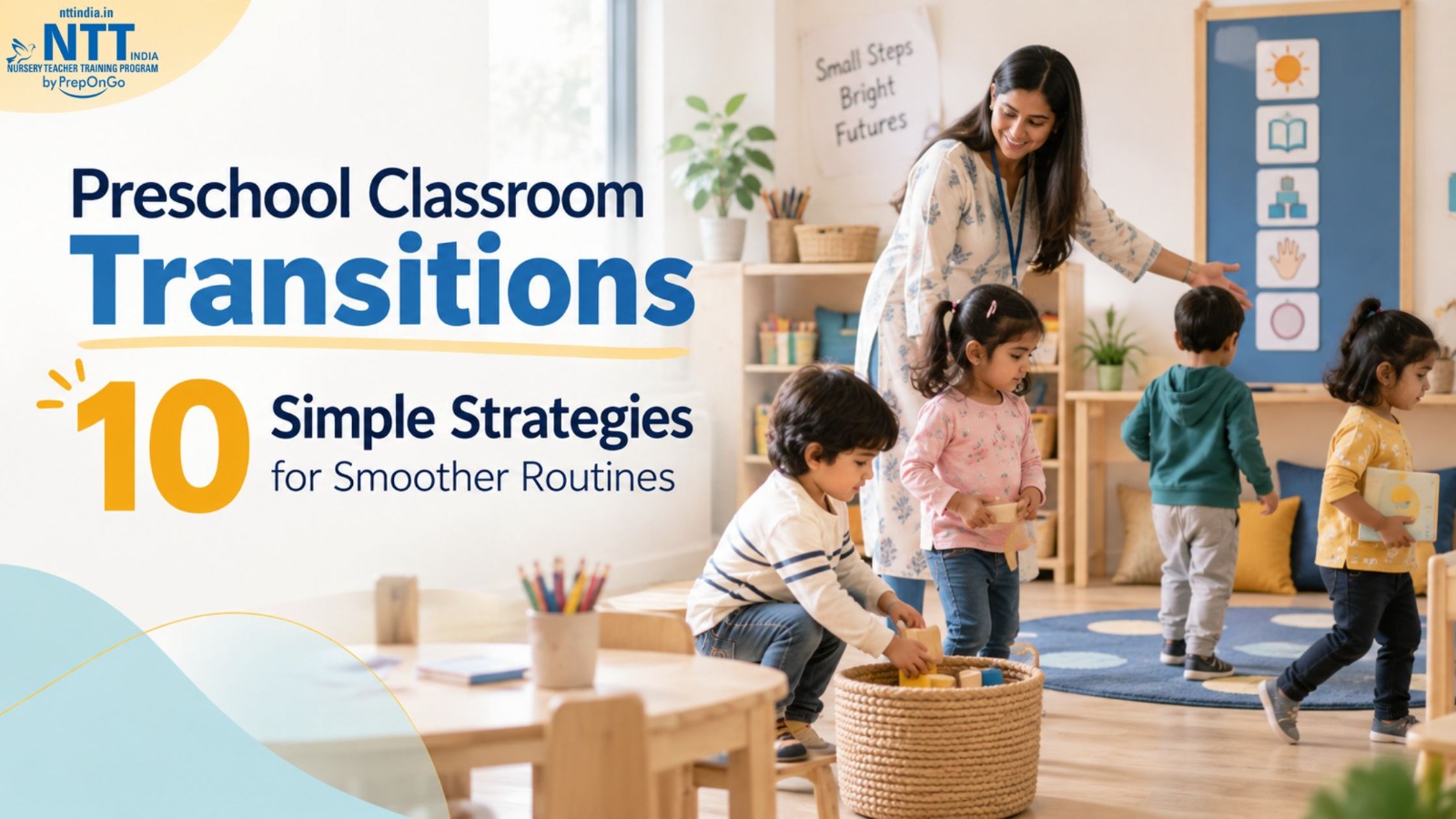
A preschool day is full of movement. Children arrive, settle into play, move to circle time, wash their hands, eat a snack, go outdoors, return for an activity, clean up and eventually prepare to go home. For an adult, these changes may look small. For a young child, each one requires stopping something, understanding what comes next, shifting attention, regulating emotions and often waiting for other children.
That is why preschool classroom transitions deserve more attention than they usually receive. A well-planned transition can protect learning time and help children feel secure. A rushed or unclear transition can quickly become the moment when a calm classroom turns noisy, children wander, and the teacher has to repeat the same instruction several times.
For aspiring early-childhood educators, learning to manage these moments is an important part of practical classroom skill. NTT India’s current ECCE programme highlights play-based pedagogy, child development, practical training and classroom-management workshops as part of educator preparation.
What Are Classroom Transitions in Preschool?
A classroom transition is the period when children move from one activity, place or routine to another. Examples include moving from free play to clean-up, from circle time to small groups, from the classroom to outdoor play, from lunch to rest time, or from school back to home.
Transitions are not simply “empty time” between lessons. They are part of the learning environment. Children practise listening, remembering steps, waiting, cooperating, organising belongings and adjusting their behaviour to a new situation. NAEYC describes routines and transitions as an essential part of creating a supportive classroom for young children. NAEYC’s routines and transitions resources also collect practical guidance for educators on making these parts of the day more supportive.
Why Do Preschoolers Find Transitions Difficult?
- Young children are still developing self-regulation. Stopping a preferred activity can be genuinely difficult, even when they understand the teacher’s instruction.
- Time is abstract. “In five minutes” may not mean much to a three- or four-year-old without an additional visual or auditory cue.
- Large-group transitions can create waiting time. Children who have finished early may not know what to do while others are still getting ready.
- Unexpected changes can feel uncomfortable. A familiar routine helps children anticipate what happens next, while sudden changes may require additional support.
- Different children need different levels of prompting. One child may respond to a verbal instruction; another may benefit from a picture cue, song, demonstration or individual reminder.
10 Practical Transition Strategies for Preschool Teachers
1. Give a short warning before the change
Instead of ending an activity without notice, prepare children for what is coming. A simple warning such as “We have two more turns, then we will tidy up” gives children time to finish what they are doing. Keep warnings brief and consistent. The purpose is not to start a long countdown; it is to make the next step predictable.
2. Use one familiar transition signal
Choose a signal children can learn to associate with a routine: a short clean-up song, a gentle bell, a clap pattern or a consistent verbal phrase. Avoid changing the signal every day. Predictability allows the cue itself to carry meaning, so the teacher needs fewer repeated instructions.
3. Show the next step visually
A simple picture schedule can make the day easier to understand. Show children what comes after the current activity: blocks → tidy-up → snack, for example. For a specific routine, use a mini-sequence such as “put toys away → wash hands → sit at the table.” Visual reminders are especially useful when verbal language alone is not enough.
4. Reduce unnecessary waiting
Many transition problems begin when children are expected to stand still with nothing to do. If some children are ready before others, give them a purposeful waiting activity: a finger rhyme, a picture book, a quiet matching task, a “find something red” challenge or a simple conversation prompt. Where possible, move children in small groups rather than waiting for the entire class to be ready at once.
5. Turn the transition into a playful task
Young children often respond better to imagination than to repeated commands. Ask them to tiptoe like mice to the reading corner, carry their water bottles “like careful waiters,” find three blue toys during clean-up, or move to the door using a simple rhythm. The game should remain quick and purposeful; it supports the routine rather than replacing it.
6. Keep directions short and concrete
During a busy transition, long explanations are difficult to process. Give one or two clear actions at a time: “Put the blocks in the basket. Then sit on the rug.” Avoid giving five instructions in a single sentence. Once children know the routine, gradually reduce prompts so they can complete more steps independently.
7. Use classroom jobs to build responsibility
Simple responsibilities can make transitions feel purposeful. A child can be the line leader, book helper, plant helper, mat collector or schedule pointer. Rotate jobs so they do not become permanent status roles. The aim is to increase participation and independence, not to reward only the quickest or most compliant child.
8. Prepare the environment before you call children
A transition becomes harder if the teacher announces the next activity and then spends several minutes searching for materials. Set up the next space before moving the group whenever possible. Put art materials out, clear the table, open the relevant learning area or place baskets where children can reach them. Good classroom management often begins before the children are asked to move.
9. Support children who need an individual cue
Not every child will respond to the whole-group signal. A teacher may need to approach one child, get to their eye level, point to the visual schedule, acknowledge that they want to keep playing, and calmly show the next step. Supporting an individual child is not “giving in”; it is adapting communication so the child can participate successfully.
10. Reflect on transitions that repeatedly go wrong
If the same part of the day becomes difficult every day, do not assume the problem is simply “bad behaviour.” Look at the routine itself. Is the transition too long? Is there too much waiting? Are the directions unclear? Does it happen when children are hungry or tired? Is the next activity ready? Reflection helps teachers improve the environment instead of relying only on correction after a problem occurs.
A Simple Transition Plan Teachers Can Use
| Transition | Advance cue | What children do | Teacher support |
| Free play → clean-up | Clean-up song + 2-minute warning | Return materials to labelled baskets | Model where items go; support one area at a time |
| Clean-up → circle time | Picture schedule | Choose a place on the rug | Invite small groups instead of creating a long line |
| Circle time → handwashing | Name 3–4 children at a time | Wash and dry hands | Give remaining children a rhyme or quiet finger game |
| Indoor → outdoor play | Show shoes/water-bottle picture cue | Collect belongings and line up | Use individual prompts for children who need extra support |
| Outdoor → classroom | Consistent bell or call-and-response | Return equipment and move indoors | Acknowledge disappointment; remind children what comes next |
What Should Teachers Avoid During Transitions?
- Shouting instructions across a noisy room.
- Using threats or shame to make children move faster.
- Expecting the whole class to wait in a line for long periods.
- Changing routines constantly without helping children understand the new sequence.
- Giving too many instructions at once.
- Assuming every child is being deliberately difficult when they struggle to stop an activity.
- Using screens simply to keep children occupied during every waiting period.
UNICEF’s guidance for teachers in the Foundational Stage emphasises sensory exploration, movement, joyful repetition, stories, songs and play-based activities as important ways young children learn. UNICEF India’s Play to Learn guidance provides useful examples of playful classroom practices that can also inspire transition activities.
Transitions Are Also Learning Opportunities
A strong preschool teacher does not treat routines as separate from learning. During clean-up, children can sort materials by type or colour. While lining up, they can practise positional words such as first, next and last. During handwashing, they can follow a sequence. While moving outdoors, they can notice sounds, shapes or weather. At snack time, they practise requesting, waiting, opening containers and cleaning their space.
This is one reason practical teacher preparation matters. NTT India describes its ECCE programme as combining child development, play-based pedagogy, foundational literacy and numeracy, classroom practice, internship and workshops. See how the ECCE programme works and explore the broader NTT India blog for additional classroom ideas.
How Transition Skills Connect With Classroom Management
Classroom management in early childhood is not mainly about controlling children. It is about designing routines, expectations, spaces and interactions that make participation easier. A teacher who anticipates difficult moments needs fewer last-minute corrections. This is especially important in preschool, where children are still learning how to regulate attention, emotion and behaviour.
For related reading, NTT India already has practical resources on preschool classroom management and keeping preschool children engaged in class. These topics work well together: engagement reduces unnecessary disruption, while predictable transitions protect the flow of the day.
Quick Transition Checklist for Preschool Teachers
- ☐ Do children know what signal means “we are changing activities”?
- ☐ Do I warn them before a preferred activity ends?
- ☐ Is the next activity ready before I move the group?
- ☐ Am I asking children to wait longer than necessary?
- ☐ Could a picture cue make the routine clearer?
- ☐ Are my instructions short enough for young children to follow?
- ☐ Do I have a plan for children who need extra transition support?
- ☐ Can the transition include movement, language, sorting or another small learning opportunity?
- ☐ After a difficult transition, do I review the routine rather than only the child’s behaviour?
Frequently Asked Questions
How long should preschool transitions take?
There is no single ideal duration. The aim is to keep transitions purposeful and as brief as the routine allows. Long periods of waiting usually create more difficulty than the actual movement between activities.
What is the best transition activity for preschoolers?
There is no universal best activity. Songs, visual cues, movement games, picture schedules and small helper jobs can all work. The most effective choice is simple, predictable and appropriate for the children and the specific routine.
What if a child refuses to transition?
Stay calm, acknowledge what the child is doing or feeling, show what comes next and offer a concrete first step. Some children benefit from an individual visual cue, limited choice or a little extra warning. Repeated difficulties are also a reason to review the timing and design of the routine.
Why are transitions important in ECCE teacher training?
Transitions combine child development, communication, classroom management, observation and planning. Teachers need to understand not only what activity to teach, but also how to move a group of young children through a full day in a safe, respectful and developmentally appropriate way.
Final Takeaway
Smooth preschool transitions do not come from making children move faster. They come from helping children understand what is happening, reducing unnecessary waiting, using predictable cues and designing routines around how young children actually learn and regulate themselves.
For a trainee teacher, mastering these everyday moments can make a noticeable difference to confidence in the classroom. Start with one difficult transition, choose one or two strategies, observe what changes, and adjust. Good routines are built through consistency and reflection—not through louder instructions.
If you are exploring professional preparation for early-childhood teaching, you can review NTT India’s current ECCE programme overview and programme journey before deciding whether it matches your career goals.
External references used
- NAEYC — Daily Routines and Classroom Transitions
- UNICEF India — Play to Learn: Practical Tips for Teachers to Support Children’s Growth