

How to Become a Preschool Teacher Without a B.Ed in India (2026)
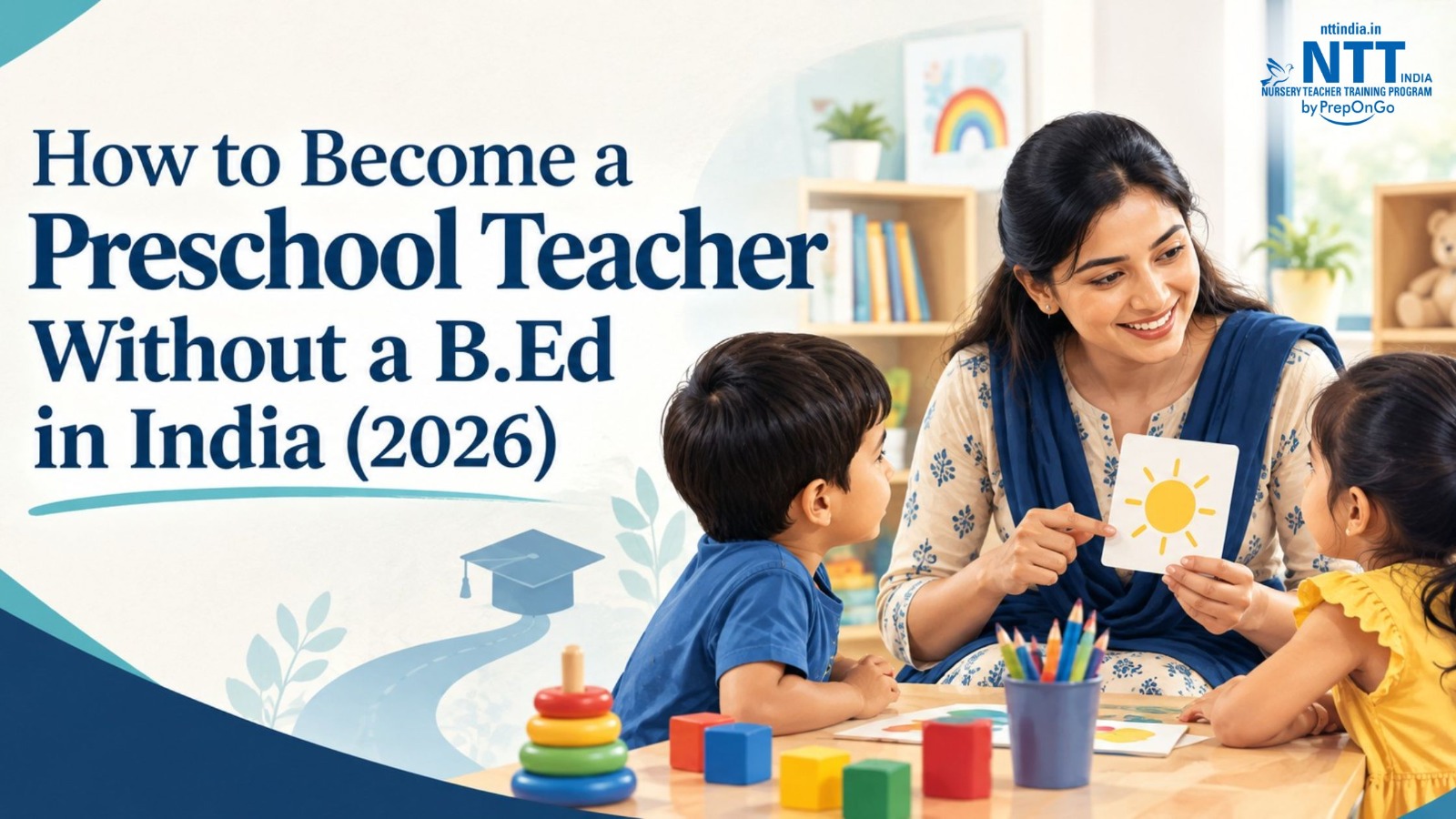
Want to become a preschool teacher but don’t have a B.Ed? The good news is that preschool and early-childhood education can follow a different career pathway from teaching higher school grades. Depending on the role and employer, specialised early-childhood qualifications such as NTT, ECCE or preschool teacher-training programmes can help prepare you for a career working with young children.
However, it is important not to assume that one qualification works for every teaching job in India. Requirements can vary by school, position, state and level of education. The National Council for Teacher Education (NCTE) separately recognises teacher-education programmes including Diploma in Preschool Education (DPSE) and Bachelor of Education (B.Ed.), reflecting the different pathways within teacher education. (NCTE)
So, if your goal is specifically preschool teaching, you may not need to begin with a B.Ed. Instead, a focused early-childhood education programme can be a practical starting point.
Can You Become a Preschool Teacher Without a B.Ed?
Yes, it can be possible to become a preschool teacher without a B.Ed., depending on the preschool, role and employer requirements.
Preschool education focuses on the development and learning of young children. Teachers working in this stage need knowledge of child development, classroom activities, play-based learning, communication, early literacy, numeracy and classroom management.
NCTE’s framework recognises Diploma in Preschool Education (DPSE) as a distinct teacher-education programme for the preschool stage. Its curriculum includes early childhood education, child development, preschool curriculum, methods and materials, practical work and school internship. (NCTE)
This is why someone interested specifically in early childhood education should look beyond the question of “Do I have a B.Ed.?” and instead ask:
“Do I have the right training and practical skills to teach young children?”
B.Ed vs NTT vs ECCE: What’s the Difference?
One of the biggest sources of confusion for aspiring teachers is assuming that B.Ed, NTT and ECCE are interchangeable.
They are not.
A B.Ed. is a broader teacher-education qualification, while NTT and ECCE are commonly associated with nursery, preschool and early-childhood education pathways.
| Qualification / Pathway | Main Focus | Potential Career Direction |
| NTT | Nursery and preschool teaching | Preschool / nursery education |
| ECCE | Early childhood care, development and education | Early childhood education |
| B.Ed. | Broader school-teaching preparation | School teaching, subject/level dependent |
| DPSE | Preschool teacher education | Preschool / early-years education |
NTT India’s own comparison explains that NTT is generally focused on nursery and preschool teaching, while ECCE is a broader area covering children’s care, development and education. (Nursery Teacher Training Program India)
If you are deciding between these options, read the detailed guide on NTT vs ECCE vs Montessori.
What Qualification Do You Need to Become a Preschool Teacher Without B.Ed?
There is no single answer that applies to every preschool in India.
Employers can set their own eligibility requirements. However, if you want to build a career in preschool education, a specialised early-childhood teacher-training programme can help you develop the knowledge and practical skills required for the classroom.
A typical pathway can look like this:
Class 12 → Preschool Teacher Training → Practical Learning → Apply for Preschool Jobs → Continue Professional Development
Depending on your goals, you may explore:
- Nursery Teacher Training (NTT)
- Early Childhood Care and Education (ECCE)
- Diploma in Preschool Education
- Other recognised or employer-accepted early-childhood teacher-training programmes
NCTE’s recognised preschool teacher-education framework includes theory, practicum and school internship, highlighting the importance of practical preparation alongside academic learning. (NCTE)
You can also explore the NTT Course in India: Complete Guide to understand the course, skills and career pathway in more detail.
Can I Become a Preschool Teacher After 12th Without B.Ed?
For many aspiring preschool educators, Class 12 can be the starting point for exploring specialised preschool teacher training, subject to the eligibility requirements of the particular programme and employer.
The important distinction is between entering a preschool-teaching pathway and qualifying for every type of school-teaching position.
For example, NCTE’s historical preschool-teacher-education norms have included entry pathways at the school level, while its current framework separately recognises preschool teacher education and B.Ed. programmes. (NCTE)
So if you have completed Class 12 and want to work with young children, you can investigate an appropriate early-childhood teacher-training course rather than assuming that a B.Ed. is your only option.
What Should You Learn in a Preschool Teacher Training Course?
A certificate alone does not automatically make someone a great preschool teacher.
The real value of teacher training is in developing practical classroom competence.
A good preschool teacher-training programme should help you understand areas such as:
- Child Development
Understand how young children develop physically, emotionally, socially and cognitively.
- Child Psychology
Learn why children behave differently and how teachers can respond appropriately.
- Classroom Management
Learn how to establish routines, manage transitions and create a positive classroom environment.
- Activity-Based Learning
Understand how games, crafts, stories, movement and hands-on activities can support learning.
- Early Literacy
Learn age-appropriate ways to introduce sounds, vocabulary, stories, phonics and early writing.
- Early Numeracy
Help children explore counting, numbers, patterns, shapes, sorting and basic mathematical thinking.
- Storytelling
Stories can help children develop vocabulary, listening skills, imagination and social understanding.
- Teaching Aids
Learn how to create and use simple materials that make lessons more interactive.
- Communication
Preschool teachers communicate not only with children but also with parents, colleagues and school leadership.
- Practical Classroom Skills
This is where theory becomes teaching.
NCTE’s preschool teacher-education framework specifically includes practical content and school internship alongside theory. (NCTE)
Why Practical Teaching Skills Matter More Than Just a Certificate
Imagine two candidates applying for the same preschool position.
Both have completed a teacher-training course.
During the interview, the principal asks:
“How would you teach colours to a group of four-year-olds?”
One candidate gives a textbook definition.
The other says:
“I would start with a colour hunt. I could ask children to find something red in the classroom, then sort objects by colour and finish with a simple art activity.”
Which answer demonstrates stronger classroom thinking?
The second.
Modern preschool teaching is not simply about knowing information. It is about knowing how to make children understand, participate and enjoy learning.
NTT India’s current interview guidance similarly emphasises communication, child psychology, practical classroom thinking and activity-based learning during preschool-teacher interviews. (Nursery Teacher Training Program India)
What Skills Do You Need to Become a Preschool Teacher?
If you’re considering this career, start building these skills early.
Patience
Young children may repeat questions, lose focus or need several attempts to understand something.
Communication
You need to explain ideas in language children can understand.
Creativity
A simple concept can become a game, story, craft activity or movement exercise.
Emotional Intelligence
Children need teachers who can recognise emotions and respond calmly.
Classroom Management
A fun classroom still needs routines, boundaries and structure.
Observation
Teachers need to notice how children participate, communicate and respond to activities.
Adaptability
Not every activity will work exactly as planned. Good teachers adjust.
Confidence
You need to be comfortable speaking, demonstrating activities and interacting with children.
For more on the qualities required in this profession, see Things to Know Before Becoming a Preschool Teacher.
What Does a Preschool Teacher Actually Do?
Being a preschool teacher involves much more than teaching ABCs and numbers.
A typical teacher may:
- Welcome children into the classroom
- Conduct circle-time activities
- Teach basic concepts
- Read stories
- Conduct art and craft activities
- Use songs and rhymes
- Introduce phonics
- Practise early numeracy
- Organise games
- Encourage social interaction
- Help children follow routines
- Observe children’s participation
- Communicate with parents
- Create teaching-learning materials
- Maintain a safe and supportive classroom
The goal is to create an environment where children feel safe enough to explore and confident enough to learn.
Where Can You Work After Preschool Teacher Training?
Depending on your qualification and the employer’s requirements, potential work settings can include:
- Preschools
- Nursery schools
- Play schools
- Early-learning centres
- Daycare centres
- Activity centres
- Some private-school early-years programmes
- Childcare and early-childhood education settings
Possible job titles can include:
Preschool Teacher
Nursery Teacher
Early Childhood Educator
Daycare Educator
Activity Teacher
Academic Coordinator
With experience and additional skills, some educators may also move toward coordination, management, teacher training or education entrepreneurship.
NTT India’s current career guide discusses several career directions available after NTT training. (Nursery Teacher Training Program India)
Can You Get a Preschool Teaching Job Without B.Ed?
Potentially, yes—but don’t confuse course completion with a guaranteed job.
Every employer can have its own eligibility criteria.
Some preschools may focus heavily on specialised early-childhood training and practical teaching ability, while others may have additional qualification requirements.
Before applying, always check the job description carefully.
Your employability can also improve if you combine:
Qualification + Practical Skills + Communication + Demo-Class Skills + Interview Preparation
For example, knowing how to conduct a good demo class can make a significant difference during hiring.
Read Preschool Demo Class Ideas: 15 Activities That Impress Principals before attending an interview.
You can also prepare using How to Crack a Preschool Teacher Interview.
How to Prepare for Your First Preschool Teacher Job
If you’re starting from zero, follow this simple plan.
Step 1: Understand the Profession
Learn what preschool teaching actually involves before choosing a course.
Step 2: Choose the Right Training
Look for a programme that includes early-childhood education, child development and practical teaching skills.
Step 3: Practise Teaching
Don’t wait until your first interview.
Practise explaining simple concepts such as:
- Colours
- Shapes
- Numbers
- Alphabets
- Animals
- Fruits
- Seasons
Step 4: Build Teaching Activities
Create simple activities using paper, blocks, flashcards, recycled materials and everyday objects.
Step 5: Learn Classroom Management
Understand how to handle transitions, noise, sharing, crying, conflicts and attention problems.
Step 6: Prepare Your Resume
Highlight your training, practical activities, skills and relevant experience.
Step 7: Practise Your Demo Class
Your demo class should show how you engage children—not simply how much information you know.
Step 8: Prepare for Interviews
Be ready for questions about child behaviour, classroom management, teaching methods and your motivation for becoming a teacher.
Do You Need B.Ed Later in Your Career?
This depends on where you want your career to go.
If your goal is specifically preschool and early-childhood education, specialised early-childhood training may be the more directly relevant starting point.
However, if your long-term goal is to move into teaching roles where a B.Ed. or another specific statutory qualification is required, you may need to pursue that qualification later.
This is why there is no universal answer to:
“Is B.Ed better than NTT?”
The better question is:
“What age group and type of teaching career do I want?”
For preschool education, early-childhood expertise is particularly relevant. For other school-teaching positions, different qualification requirements may apply.
NCTE separately lists DPSE and B.Ed. among its teacher-education programmes, reinforcing that these pathways serve different purposes. (NCTE)
Is NTT a Good Option for Someone Who Doesn’t Have B.Ed?
If your goal is to work specifically with nursery and preschool-age children, an NTT programme can be one pathway worth exploring.
NTT focuses on preparing educators for the early-years classroom, including areas such as:
- Child psychology
- Teaching methods
- Classroom management
- Early childhood education
- Activity-based learning
- Communication
- Practical teaching skills
NTT India’s course guide describes NTT as a professional diploma pathway focused on preschool teaching, child psychology and early-childhood teaching techniques. (Nursery Teacher Training Program India)
Before enrolling, compare the curriculum, eligibility, practical training, certification and career support rather than choosing a course based only on its name.
What About ECCE?
ECCE stands for Early Childhood Care and Education.
It focuses on children’s development, care and education during the early years.
ECCE can cover areas such as:
- Child development
- Child psychology
- Early literacy
- Early numeracy
- Social-emotional development
- Play-based learning
- Creative activities
- Child care
- Developmentally appropriate teaching
NTT India’s current NTT vs ECCE vs Montessori guide explains that ECCE is broader than simply a teacher-training label and covers multiple aspects of early childhood development and education. (Nursery Teacher Training Program India)
If you’re deciding between NTT and ECCE, look at your career goal and the actual curriculum before making your choice.
A Simple Career Roadmap
If your goal is to become a preschool teacher without starting with B.Ed., your journey could look like this:
CLASS 12
↓
CHOOSE AN EARLY-CHILDHOOD TEACHER-TRAINING PROGRAMME
↓
LEARN CHILD DEVELOPMENT + TEACHING METHODS
↓
BUILD PRACTICAL CLASSROOM SKILLS
↓
PRACTISE DEMO CLASSES
↓
CREATE YOUR TEACHER RESUME
↓
APPLY TO PRESCHOOLS
↓
GAIN CLASSROOM EXPERIENCE
↓
CONTINUE LEARNING & SPECIALISING
The most important step is not simply completing a course. It is becoming confident enough to turn what you learn into meaningful classroom experiences for children.
Frequently Asked Questions
-
Can I become a preschool teacher without a B.Ed.?
Yes, it can be possible depending on the preschool and position. Specialised early-childhood qualifications may provide a relevant pathway for preschool teaching, but individual employers can have different requirements.
-
Can I become a preschool teacher after 12th without B.Ed.?
You may be able to begin an early-childhood teacher-training pathway after Class 12, depending on the eligibility criteria of the programme you choose.
-
Is NTT enough to become a preschool teacher?
NTT can provide specialised training for preschool teaching, but completing an NTT course does not guarantee employment. Always check the qualification requirements of the preschool where you plan to apply.
-
Is ECCE better than B.Ed.?
Neither is universally better. They serve different purposes. ECCE focuses on early childhood, while B.Ed. is a broader teacher-education pathway. Your intended age group and career goal should guide your choice.
-
Can a homemaker become a preschool teacher without B.Ed.?
Yes. A homemaker who meets the eligibility requirements can pursue early-childhood teacher training and develop the skills needed to enter preschool education.
-
Can I teach in a primary or secondary school without B.Ed.?
Do not assume that a preschool-teaching qualification automatically qualifies you for every school-teaching position. Requirements depend on the post, institution and applicable recruitment rules.
-
What skills should I learn before becoming a preschool teacher?
Focus on child psychology, communication, classroom management, storytelling, activity-based learning, early literacy, early numeracy, observation and emotional intelligence.
-
Does completing NTT guarantee a preschool teaching job?
No. A qualification can support your preparation, but employment depends on factors such as the employer’s eligibility criteria, your practical skills, interview performance and experience.
Final Thoughts
You do not have to assume that B.Ed. is the only route into early-childhood education.
If your goal is to work with preschool children, the more useful question is:
“Am I properly trained to understand, teach and support young children?”
A focused early-childhood programme such as NTT or ECCE can help you build relevant knowledge and practical teaching skills, subject to the requirements of the programme and employer.
At the same time, always remember that preschool teaching, primary-school teaching and secondary-school teaching can have different qualification requirements. Check the specific requirements for the role you want rather than relying on a general rule. NCTE’s framework recognises separate pathways for preschool education and B.Ed. teacher education. (NCTE)
If you’re ready to explore preschool teaching as a career, start by understanding the NTT Course in India and the skills required to become a confident early-childhood educator.
Your first classroom may be small. The impact you make can last a lifetime.