


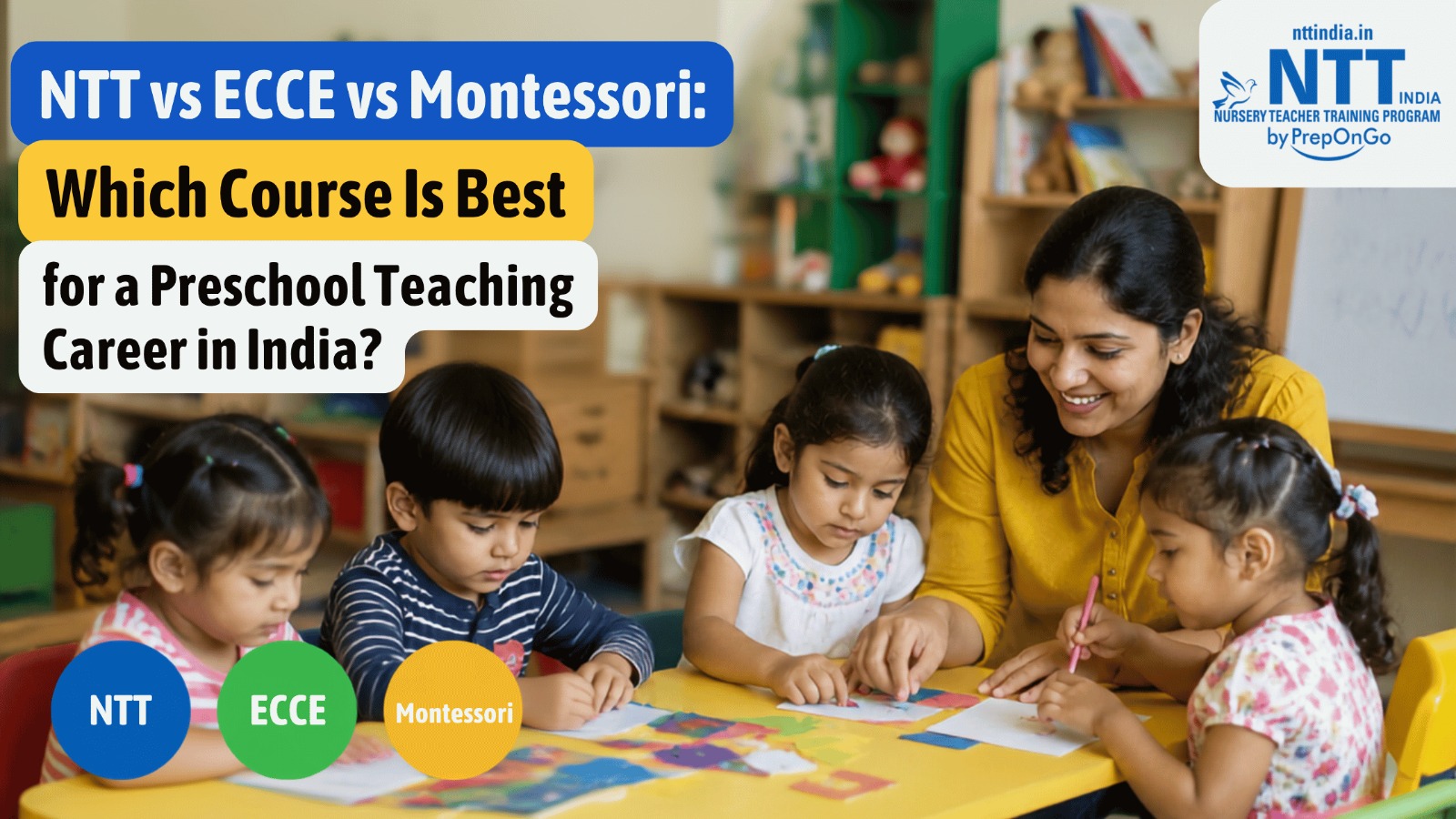
NTT vs ECCE vs Montessori: Which Course Is Best for a Preschool Teaching Career in India?
If you are planning a career in preschool teaching, you may have come across three popular terms: NTT, ECCE and Montessori.
At first glance, they may appear to be different names for the same type of teacher training. They are not.
NTT (Nursery Teacher Training) is generally focused on preparing educators for nursery and preschool teaching.
ECCE (Early Childhood Care and Education) is a broader field covering children’s care, development and education during the early years.
Montessori is a specific educational philosophy and teaching approach, with specialized teacher-training programs designed around Montessori principles.
So, NTT vs ECCE vs Montessori—which one is best for a preschool teaching career in India?
The short answer:
If your primary goal is to become a nursery or preschool teacher, NTT can be a direct choice for preschool-focused teacher preparation. If you want broader knowledge of early childhood development and education, ECCE may be more suitable. If you specifically want to teach using the Montessori approach, Montessori teacher training is the more specialized option.
The right choice ultimately depends on the age group you want to teach, the type of school you want to work in and the teaching approach you want to follow.
Let’s compare all three in detail.
NTT vs ECCE vs Montessori: At a Glance
| Factor | NTT | ECCE | Montessori |
| Full Form | Nursery Teacher Training | Early Childhood Care and Education | Montessori Education / Teacher Training |
| Main Focus | Nursery and preschool teacher preparation | Holistic early childhood care, development and education | Montessori philosophy and pedagogy |
| Approach | Preschool teaching methods and practical classroom skills | Broad developmental and educational approach | Specialized child-centered Montessori approach |
| Child Development | Important component | Central focus | Central component |
| Classroom Management | Usually covered | Usually covered | Covered within Montessori practice |
| Lesson Planning | Generally covered | Generally covered | Montessori activity planning |
| Teaching Aids | Commonly included | May be included | Montessori materials are central |
| Best For | Aspiring nursery/preschool teachers | Aspiring early childhood educators | People specifically interested in Montessori education |
| Career Direction | Preschool/nursery teaching and related roles | Broader early childhood education roles | Montessori classrooms and related roles |
Note: Course content, duration, certification and eligibility can vary between institutions. Always check the exact curriculum and qualification offered by the institute before enrolling.
What Is NTT?
NTT stands for Nursery Teacher Training.
It is generally designed for people who want to develop the knowledge and practical skills required to work with young children in nursery, preschool and early-learning environments.
A preschool teacher does much more than teach alphabets, numbers and rhymes. Young children are developing socially, emotionally, physically, cognitively and linguistically at the same time.
Therefore, preschool teacher preparation can include areas such as:
- Child development
- Child psychology
- Early childhood education
- Teaching methodologies
- Classroom management
- Lesson planning
- Activity-based learning
- Storytelling
- Creative activities
- Teaching aids
- Communication skills
NTT India’s current course information describes its NTT program around areas including child psychology, early childhood education, teaching methodologies and practical preparation for preschool classrooms.
Who Should Consider NTT?
NTT may be suitable if you:
- Want to become a preschool or nursery teacher
- Enjoy working with young children
- Want practical preschool teaching skills
- Want to learn different classroom activities
- Are interested in child development
- Want to start a career in early childhood education
- Are looking for a teaching-focused professional course
What Is ECCE?
ECCE stands for Early Childhood Care and Education.
Unlike NTT, which is commonly used as the name of a teacher-training pathway, ECCE represents a broader area of early childhood care, development and education.
India’s National Curriculum Framework for the Foundational Stage describes ECCE around children’s physical, cognitive, socio-emotional, cultural, artistic, communication, early literacy and numeracy development. It also emphasizes play-based, activity-based and inquiry-based learning.
This means ECCE is not simply about teaching children academic concepts.
It is about understanding how young children grow, learn, communicate, interact and develop.
ECCE Can Cover Areas Such As:
- Child development
- Child psychology
- Physical development
- Cognitive development
- Social and emotional development
- Language development
- Early literacy
- Early numeracy
- Play-based learning
- Creative activities
- Child care
- Developmentally appropriate teaching
Who Should Consider ECCE?
ECCE may be suitable if you:
- Want a broader understanding of early childhood education
- Are interested in child development
- Want to understand children’s learning needs
- Want to work in early childhood education
- Are interested in holistic development
- Want to explore different early-years education roles
What Is Montessori Teacher Training?
Montessori is different from NTT and ECCE because it refers to a specific educational philosophy and pedagogy.
Developed from the work of Dr. Maria Montessori, Montessori education emphasizes a carefully prepared environment, hands-on learning, independence, observation and developmentally appropriate materials.
Montessori teacher training is therefore designed around learning and applying this particular educational approach.
The Association Montessori Internationale (AMI), for example, offers teacher-training programs for different age levels, including 0–3, 3–6, 0–6, 6–12 and 12–18 years.
A Montessori-focused training pathway can include areas such as:
- Montessori philosophy
- Child development
- Observation
- Prepared environment
- Practical life activities
- Sensorial activities
- Montessori language materials
- Montessori mathematics materials
- Classroom practice
- Teacher observation and guidance
Who Should Consider Montessori?
Montessori training may be a good fit if you:
- Specifically want to work in a Montessori environment
- Are interested in Montessori philosophy
- Prefer hands-on learning
- Want specialized Montessori training
- Enjoy observing and guiding children’s independent learning
- Want to work with Montessori materials and methodology
NTT vs ECCE vs Montessori: What Is the Biggest Difference?
The easiest way to understand the difference is to look at the purpose of each pathway.
NTT = Preschool Teacher Preparation
The emphasis is on preparing you for the responsibilities of teaching young children in nursery and preschool environments.
ECCE = Broader Early Childhood Education
The emphasis is on understanding children’s early development, care and education from a broader perspective.
Montessori = Specialized Teaching Methodology
The emphasis is on learning and applying the Montessori philosophy and classroom methodology.
So, these three should not necessarily be viewed as competing courses.
They can represent different directions within early childhood education.
NTT vs ECCE vs Montessori: Which Has the Best Teaching Approach?
There is no universally “best” teaching approach.
The better question is:
Which teaching approach matches the kind of educator you want to become?
NTT Teaching Approach
NTT-focused training can expose aspiring teachers to a variety of preschool teaching techniques.
These may include:
- Storytelling
- Rhymes
- Songs
- Games
- Art and craft
- Activity-based learning
- Demonstrations
- Teaching aids
- Classroom activities
The exact curriculum depends on the institution.
ECCE Teaching Approach
ECCE emphasizes holistic development.
India’s Foundational Stage framework specifically emphasizes flexible, multi-level, play-based, activity-based and inquiry-based learning.
This means children should have opportunities to:
- Explore
- Play
- Ask questions
- Experiment
- Create
- Communicate
- Solve problems
- Interact with others
Montessori Teaching Approach
Montessori follows a more specific methodology.
Instead of relying primarily on teacher-led instruction, the Montessori environment is designed to allow children to interact with materials, make choices and develop independence.
The teacher’s role involves careful observation and guidance.
This is one reason Montessori training is best understood as specialized pedagogical training, rather than simply another name for preschool teacher training.
What Does India’s Education Framework Say About Early Learning?
Early childhood education is not a minor part of India’s current education framework.
The National Curriculum Framework for the Foundational Stage identifies the Foundational Stage as covering ages 3 to 8, including three years of preschool followed by Grades 1 and 2.
It emphasizes that children learn through:
- Play
- Activity
- Exploration
- Observation
- Interaction
- Concrete experiences
- Collaboration
The framework also identifies development across multiple domains, including physical, cognitive, socio-emotional, communication, language, literacy and numeracy.
What does this mean for aspiring teachers?
It means that today’s preschool educator needs more than the ability to keep children occupied.
A strong early-years teacher needs to understand how children learn and how to create meaningful learning experiences.
NTT vs ECCE vs Montessori: Career Opportunities
Your intended career should be one of the biggest factors in choosing a course.
Career Options After NTT
Depending on your qualification and the requirements of individual employers, NTT-trained candidates may explore roles such as:
- Nursery Teacher
- Preschool Teacher
- Pre-Primary Teacher
- Assistant Teacher
- Early Years Educator
- Daycare Educator
- Activity Teacher
- Preschool Coordinator
NTT India’s career information also highlights teaching and other early-childhood-related opportunities after completing its program.
Career Options Related to ECCE
Depending on the specific qualification and employer requirements, ECCE-trained candidates may explore roles such as:
- Preschool Educator
- Early Childhood Educator
- Nursery Teacher
- Teaching Assistant
- Childcare Educator
- Curriculum Support Roles
- Early Years Coordinator
Career Options After Montessori Training
Montessori-specific training can be particularly relevant to Montessori environments.
Potential roles include:
- Montessori Teacher
- Montessori Assistant
- Montessori Guide
- Early Childhood Educator
- Classroom Assistant
- Montessori Coordinator
The exact role and eligibility will depend on the institution, employer and level of Montessori training.
Which Course Is Best After Class 12?
If you have completed Class 12 and are considering preschool teaching as a career, you may be wondering where to start.
There isn’t one universal answer.
If your goal is:
“I want to become a nursery or preschool teacher.”
→ Explore NTT-focused teacher training.
“I want to understand early childhood development and education more broadly.”
→ Explore ECCE-focused programs.
“I specifically want to teach using Montessori methodology.”
→ Explore Montessori teacher training.
The important point is to compare the actual course rather than choosing based only on the name.
Which Course Is Best for a Career in Montessori Schools?
If your specific goal is to work in a Montessori school, specialized Montessori training can provide knowledge of the Montessori approach that a general preschool-teacher program may not provide to the same depth.
For example, AMI offers dedicated training for specific age levels and Montessori methodology.
Therefore:
Want Montessori specialization? → Montessori training
Want broader preschool teaching preparation? → NTT
Want broader early childhood education knowledge? → ECCE
Which Course Is Best for a General Preschool Career?
If you want to work in a conventional preschool, nursery or early-learning centre and want training specifically oriented toward preschool teaching, NTT can be a direct option to explore.
NTT India describes its program as preparing aspiring educators in areas such as child psychology, teaching methodologies, classroom management and modern teaching practices.
However, the school or employer may have its own eligibility requirements.
Always check the requirements for the specific role you want.
NTT vs ECCE vs Montessori: What Should You Check Before Enrolling?
Don’t choose a teacher-training course just because its title sounds attractive.
Before enrolling, check these 10 things:
- Curriculum
Does the curriculum actually cover the skills you want to develop?
- Practical Training
Does the program provide opportunities to apply what you learn?
- Teaching Methodology
Will you learn different approaches to engaging young children?
- Child Development
Does the course help you understand how children develop and learn?
- Classroom Management
Will you learn how to handle real preschool classroom situations?
- Teaching Aids
Will you learn how to create and use age-appropriate teaching materials?
- Qualification
What certificate, diploma or qualification will you receive?
- Eligibility
What educational background is required?
- Career Support
Does the institute provide career guidance or placement-related support?
- Learning Format
Is the course online, offline, hybrid or practical?
These questions can help you compare courses objectively instead of choosing based only on advertising claims.
Why Practical Skills Matter More Than a Certificate Alone
A preschool classroom is unpredictable.
One child may be excited to participate.
Another may be shy.
Another may struggle to follow instructions.
Another may need more individual attention.
A teacher therefore needs to understand children—not simply deliver lessons.
Professional training can help aspiring educators develop skills related to:
- Child psychology
- Observation
- Communication
- Activity planning
- Classroom management
- Creative teaching
- Teaching aids
- Behaviour guidance
- Parent communication
NTT India’s own teacher-training content emphasizes that modern preschool educators need knowledge of child development, classroom management, behaviour guidance, activity planning and assessment—not simply enthusiasm for working with children.
A Simple Decision Guide: NTT vs ECCE vs Montessori
Still confused?
Use this simple decision framework.
Choose NTT if:
Your goal: Become a nursery/preschool teacher
Your priority: Practical preschool teaching preparation
You want: A broad set of classroom and teaching skills
Choose ECCE if:
Your goal: Build knowledge of early childhood care and education
Your priority: Child development and holistic early learning
You want: A broader early childhood education perspective
Choose Montessori if:
Your goal: Work specifically with Montessori methodology
Your priority: Montessori philosophy and practice
You want: Specialized Montessori classroom preparation
NTT vs ECCE vs Montessori: Which One Is Better?
The answer depends on your career goal—not which course sounds more advanced.
If you want to become a preschool or nursery teacher and are looking for teacher-focused preparation, NTT is a strong option to consider.
If you want broader knowledge of children’s development, care and education, ECCE may be the better fit.
If you are specifically interested in Montessori philosophy and want to work in Montessori environments, Montessori training is the more targeted pathway.
In one line:
NTT = Preschool teacher preparation
ECCE = Broad early childhood education
Montessori = Specialized Montessori pedagogy
There is no single winner.
The best course is the one that matches where you want your teaching career to go.
Why Choose NTT India for Preschool Teacher Training?
If your goal is to develop a career in preschool and early childhood education, the next step is to examine the actual curriculum, practical learning and career support offered by the institute.
NTT India positions its training around modern teaching practices, child psychology, early childhood education, teaching methodologies and classroom preparation.
The program is designed for people interested in building a career in early childhood education, including fresh learners and people looking to develop or restart their professional journey. NTT India’s recent career content also highlights preschool teaching, assistant teaching and related early-childhood opportunities.
👉 Explore NTT India’s Nursery Teacher Training Program
👉 Explore Career Opportunities After NTT
Frequently Asked Questions
Is NTT the same as ECCE?
No. NTT generally refers to Nursery Teacher Training, while ECCE stands for Early Childhood Care and Education and represents a broader area of early childhood development, care and education.
Is Montessori the same as NTT?
No. NTT is generally focused on nursery and preschool teacher preparation, while Montessori is a specific educational philosophy and methodology.
Which is better: NTT or ECCE?
Neither is universally better. NTT may be more directly aligned with someone seeking nursery or preschool teacher preparation, while ECCE offers a broader early childhood education perspective.
Which is better: NTT or Montessori?
It depends on your career goal. If you want general preschool teaching preparation, NTT may be worth considering. If you specifically want to teach using Montessori methodology, specialized Montessori training may be more appropriate.
Can I become a preschool teacher after NTT?
NTT is designed around nursery and preschool teacher preparation. However, individual schools may have their own eligibility requirements, so always check the requirements for the specific position you are applying for.
Is ECCE useful for preschool teaching in India?
Yes. ECCE directly relates to early childhood care, development and education, which is an important part of India’s Foundational Stage framework. The National Curriculum Framework emphasizes play-based, activity-based and inquiry-based learning during these years.
Is Montessori training useful for preschool teachers?
Yes, particularly for people who want to work in Montessori environments. Montessori training provides specialized preparation in Montessori principles, materials and classroom practice. AMI offers dedicated training programs for different age levels, including 3–6 years.
What should I consider before choosing an NTT course?
Look at the curriculum, practical training, qualification awarded, eligibility, teaching methodology, faculty, learning format, career guidance and the specific preschool roles the program prepares you for.
Final Takeaway
Choosing between NTT, ECCE and Montessori does not have to be confusing.
Think about the destination first.
If you want to build a career as a nursery or preschool teacher, explore NTT.
If you want a broader understanding of early childhood care, development and education, explore ECCE.
If you want to specialize in the Montessori educational approach, explore Montessori teacher training.
Whichever route you choose, remember that effective preschool education depends on more than completing a course.
It requires an understanding of children, strong communication, creativity, patience, observation, classroom skills and the ability to turn everyday activities into meaningful learning experiences.
Your first step is choosing the training that matches the educator you want to become.
Related NTT India Resources
- NTT Course in India: Complete Guide to Nursery Teacher Training, Career Scope & Opportunities
- How to Become a Preschool Teacher in India: Complete Step-by-Step Guide
- ECCE Program vs B.Ed.: Which Is Better for a Teaching Career in India?
- How NTT India Prepares You for a Successful Teaching Career
- Lesson Planning for Preschool Teachers