






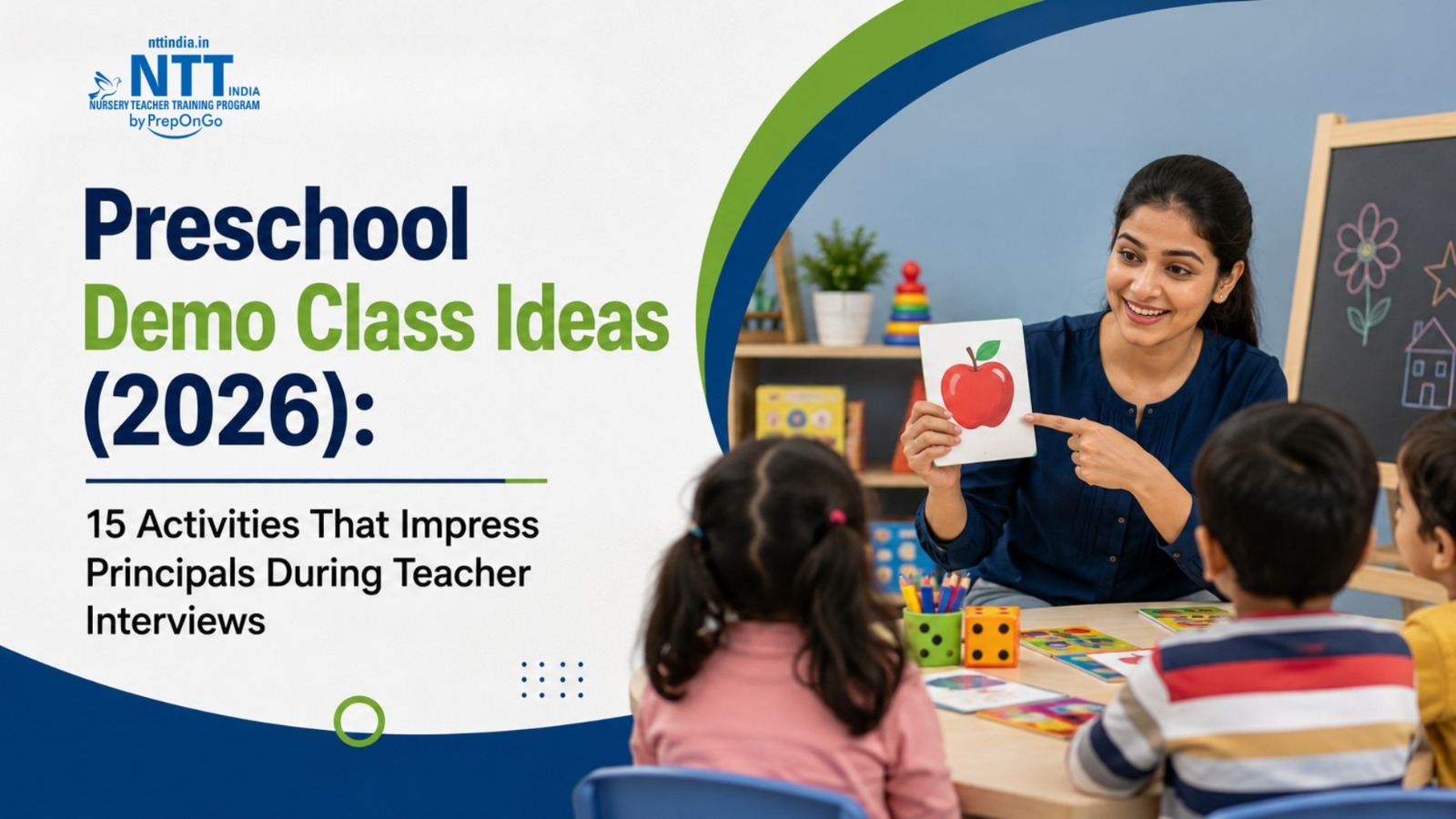
Preschool Demo Class Ideas (2026): 15 Activities That Impress Principals During Teacher Interviews
Getting shortlisted for a preschool teaching job is exciting.
But there’s one stage that makes many candidates nervous—the demo class.
Unlike a traditional interview, a demo class lets principals observe your teaching style in action. They’re not just listening to your answers; they’re watching how you connect with children, explain concepts, manage the classroom, and create an engaging learning experience.
The good news?
A successful demo class doesn’t require expensive materials or complicated lesson plans. What matters most is your ability to keep children involved, communicate clearly, and make learning enjoyable. Schools typically evaluate classroom presence, student engagement, clarity of instruction, and how naturally you interact with learners during a short 10–20 minute session.
If you’re preparing for your first teaching interview, this guide will give you practical demo class ideas that leave a lasting impression.
Before attending interviews, make sure your resume is interview-ready by reading:
👉 Preschool Teacher Resume Format with Free Sample (2026)
What Is a Preschool Demo Class?
A preschool demo class is a short teaching session conducted during the recruitment process.
Usually lasting 10–15 minutes, it allows the interview panel to evaluate how effectively you teach young children.
During the session, principals typically observe:
- Communication skills
- Classroom confidence
- Child engagement
- Activity planning
- Voice modulation
- Creativity
- Behaviour management
- Lesson flow
Many schools consider the demo class even more important than the interview because it demonstrates how you actually teach, not just how you answer questions.
What Principals Really Look For
Many candidates believe principals are judging their knowledge.
Actually, they observe much more.
They want to see whether you can:
✔ Make children smile
✔ Encourage participation
✔ Explain concepts simply
✔ Handle unexpected situations calmly
✔ Keep every child engaged
✔ Create a positive classroom atmosphere
Remember:
Children should be doing more than listening.
Interactive, hands-on learning consistently makes a stronger impression than long explanations. Experienced teachers also recommend keeping students active throughout the lesson rather than turning the demo into a lecture.
How to Structure a Winning Demo Class
A simple five-step structure works well for most preschool interviews.
1. Warm Welcome (1 minute)
Smile.
Introduce yourself.
Create excitement.
Example:
“Good morning, everyone! My name is Teacher Ananya. Today we’re going to have lots of fun together!”
2. Icebreaker (2 minutes)
Start with something energetic.
Examples:
- Hello Song
- Clap Pattern
- Action Rhyme
- Name Game
Children become comfortable immediately.
3. Main Learning Activity (6–8 minutes)
Introduce one concept only.
Examples:
- Colours
- Shapes
- Fruits
- Animals
- Numbers
- Alphabet
Avoid teaching multiple concepts in one demo.
4. Quick Activity (3 minutes)
Allow children to participate.
Examples:
- Matching cards
- Sorting objects
- Flashcards
- Colour hunt
- Story response
- Puppet interaction
Interview panels generally value activities where children actively think, answer, move, or create instead of passively listening.
5. Revision & Appreciation (1 minute)
Ask:
“What colour is this?”
“What shape is this?”
“Who remembers today’s story?”
Finish positively.
15 Preschool Demo Class Activities That Impress Principals
Activity 1 — Colour Hunt
Topic
Colours
Materials
- Colour flashcards
- Classroom objects
How It Works
Show a colour card.
Ask:
“Can everyone find something red?”
Children quickly look around the classroom.
They point to objects.
Everyone participates.
Why Principals Love It
✔ Movement
✔ Observation
✔ Interaction
✔ Confidence
Activity 2 — Mystery Bag
Children love surprises.
Place different objects inside a colourful cloth bag.
Examples:
- Apple
- Toy car
- Spoon
- Teddy bear
- Ball
A child picks one object without looking.
Ask:
“What do you think it is?”
After guessing,
they remove it.
Now discuss:
- Colour
- Shape
- Texture
- Uses
This activity develops vocabulary, observation skills, and curiosity.
Activity 3 — Story Basket
Instead of simply reading a story,
carry a small basket containing:
- Puppet
- Toy rabbit
- Small tree
- Artificial flowers
While telling the story,
take each object out.
Children remain engaged because they can see the story unfolding.
Storytelling supported by visual props is a proven way to sustain attention and encourage language development in preschool classrooms.
Activity 4 — Shape Detective
Teach:
Circle
Triangle
Square
Rectangle
Now ask children:
“Can you find a circle in our classroom?”
Children start exploring.
Learning becomes active instead of passive.
This also demonstrates your ability to integrate movement into learning.
Activity 5 — Animal Action Game
Show an animal flashcard.
Examples:
🐘 Elephant
🐸 Frog
🐰 Rabbit
🦆 Duck
Children imitate:
- Walking
- Jumping
- Flying
- Crawling
This activity combines gross motor development with vocabulary learning while keeping energy levels high.
Activity 6 — Letter Fishing Game
Topic
Alphabet Recognition
Materials
- Paper fish with letters
- Small magnetic fishing rod (or paper clips with a stick)
How It Works
Spread the alphabet fish on the floor.
Invite each child to catch one.
Ask:
“What letter did you catch?”
Then encourage the child to say:
- One word beginning with that letter
- The letter sound (if age-appropriate)
Why Principals Love It
✔ Fun learning
✔ Child participation
✔ Language development
✔ Fine motor skills
Activity 7 — Feel & Guess Box
Topic
Sensory Learning
Place different objects inside a covered box.
Examples:
- Cotton
- Toy ball
- Leaf
- Sponge
- Wooden block
Children touch an object without seeing it.
Ask:
“How does it feel?”
Then reveal the object.
This activity develops vocabulary, sensory awareness, and confidence.
Activity 8 — Puppet Conversation
Bring a simple hand puppet.
Instead of asking questions yourself,
let the puppet ask them.
Example:
“Hello! My name is Bunny. Can you tell me your favourite colour?”
Children naturally become more engaged with puppets than with direct questioning. Puppets encourage conversation, imagination, and participation in early childhood classrooms.
Activity 9 — Action Rhyme
Examples:
- Head, Shoulders, Knees and Toes
- If You’re Happy and You Know It
Encourage children to:
- Clap
- Jump
- Stretch
- Turn around
Movement keeps preschoolers attentive while supporting gross motor development.
Activity 10 — Sorting Game
Provide:
- Buttons
- Blocks
- Pom-poms
- Leaves
Ask children to sort by:
- Colour
- Shape
- Size
Simple sorting activities strengthen observation and logical thinking while keeping children actively involved.
Activity 11 — Emotion Cards
Show different facial expression cards.
😀 Happy
😢 Sad
😡 Angry
😲 Surprised
Ask:
“When do you feel happy?”
This activity develops emotional vocabulary and communication skills.
Activity 12 — Build With Blocks
Give children building blocks.
Challenge them:
“Can you build the tallest tower?”
Observe:
- Creativity
- Teamwork
- Problem-solving
Rather than correcting every attempt, encourage children to think about why a tower falls and how they might improve it. Open-ended guidance supports deeper learning than simply giving the answer.
Activity 13 — Picture Story Sequencing
Show four simple picture cards.
Example:
- Seed
- Plant
- Flower
- Butterfly
Ask children to arrange them in order.
This strengthens:
- Logical thinking
- Language development
- Memory
Activity 14 — Mystery Sound Game
Play sounds such as:
🐶 Dog
🚗 Car
🌧 Rain
🐦 Bird
Children guess the sound.
Then ask:
“Where do we hear this?”
Excellent for listening skills and vocabulary.
Activity 15 — Goodbye Reflection Circle
Before ending your class,
sit with the children.
Ask:
“What did you enjoy today?”
or
“Who can tell me one new thing they learned?”
Reflection helps children recall learning and gives interviewers a chance to see your communication style and classroom rapport.
7 Mistakes That Can Ruin Your Demo Class
Many candidates lose opportunities because of small mistakes—not because they lack teaching ability.
Avoid these:
❌ Teaching too much
Focus on one concept only.
❌ Talking continuously
Children should participate more than they listen.
❌ Ignoring shy children
Invite every child to participate.
❌ Standing in one place
Move around the classroom naturally.
❌ Speaking too fast
Use a calm, cheerful voice.
❌ Correcting children harshly
Instead of saying:
“Wrong.”
Say:
“That’s a good try. Let’s think together.”
A positive, emotionally supportive classroom is a hallmark of quality preschool teaching.
❌ Forgetting to appreciate children
Always end with encouragement.
Simple praise such as:
“Wonderful!”
“Excellent effort!”
creates a positive learning environment.
What Principals Observe During Your Demo
Many candidates think principals only evaluate subject knowledge.
In reality, they observe:
- Your smile
- Voice modulation
- Eye contact
- Energy level
- Classroom management
- Creativity
- Confidence
- Child engagement
- Professionalism
Remember:
Children may forget your lesson.
They won’t forget how you made them feel.
Sample 10-Minute Demo Class Plan
| Time | Activity | |
| 1 Minute | Greeting & Introduction | |
| 2 Minutes | Action Song / Icebreaker | |
| 4 Minutes | Main Learning Activity | |
| 2 Minutes | Interactive Game | |
| 1 Minute | Revision & Appreciation |
This structure is simple, balanced, and easy for interview panels to follow.
Demo Class Checklist
Before entering the classroom, make sure you have:
✔ Flashcards
✔ Storybook or puppet
✔ Crayons or markers
✔ Activity material
✔ Smile 😊
✔ Water bottle
✔ Lesson objective in mind
✔ Positive attitude
Before Your Interview…
Prepare these essentials too:
📌 Professional Resume
https://nttindia.in/preschool-teacher-resume-format-with-free-sample-2026-complete-guide-for-freshers-experienced-teachers/
📌 Interview Questions
https://nttindia.in/preschool-teacher-interview-questions-answers-2026
📌 Lesson Planning Guide
📌 Play-Based Learning
https://nttindia.in/why-play-based-learning-is-the-future-of-preschool-education-in-india/
Frequently Asked Questions
How long should a preschool demo class be?
Most schools conduct demo classes lasting 10–20 minutes. Keep the lesson focused on one concept and include at least one interactive activity.
What topic is best for a preschool demo class?
Popular choices include:
- Colours
- Shapes
- Animals
- Fruits
- Numbers
- Alphabet
- Seasons
These topics are familiar, interactive, and easy to teach within a short session.
Can I use flashcards in a demo class?
Yes.
Flashcards, puppets, props, songs, and simple classroom materials make lessons more engaging when used thoughtfully rather than excessively.
What if children don’t respond during the demo?
Stay calm.
Use open-ended questions, songs, movement, or visual aids to encourage participation. Avoid putting pressure on children to answer immediately.
Final Thoughts
A successful preschool demo class isn’t about delivering the most complicated lesson—it’s about creating a joyful learning experience.
Principals remember teachers who:
- Build rapport quickly
- Encourage every child
- Keep learning interactive
- Communicate with warmth and confidence
- End the class on a positive note
With preparation, practice, and the right teaching approach, your demo class can become the moment that earns you the job.
Ready to Build Your Preschool Teaching Career?
At NTT India, aspiring educators receive practical training in lesson planning, child psychology, classroom management, and activity-based learning to prepare them for real preschool classrooms.
Explore our programs and start your journey today:
Courses: https://nttindia.in/courses/
Blog: https://nttindia.in/blog/
Certified Preschool Teacher Guide: https://nttindia.in/how-to-become-a-certified-preschool-teacher-in-india-complete-guide-2026/
The best demo class doesn’t showcase how much you know—it showcases how well you help children learn, explore, and enjoy the experience.